Baker McKenzie's AI Layoffs Are a Warning: Here's What Smart Firms Are Doing Instead.

When Baker McKenzie announced plans to cut roughly 700 business services staff earlier this month, the firm pointed squarely at AI as a driving force. The cuts spanned IT, knowledge management, marketing, admin, and design teams across virtually every global office. It was one of the largest AI-attributed layoffs in legal industry history, and it sent a clear signal through the profession: the AI transformation of legal services is no longer theoretical.
But here is the part the headlines are missing. Swapping headcount for software licenses is not a legal engineering strategy. It is a cost-cutting exercise dressed up in innovation language. And firms that confuse the two are setting themselves up for the same kind of overestimation that already burned Salesforce, which discovered by late 2025 that its own AI agents failed the majority of customer experience tasks.
The real question for law firm leaders is not whether AI will change legal practice. It already has. The question is whether your firm is engineering its operations around AI thoughtfully or simply hoping the technology will fill the gaps left by departed employees.
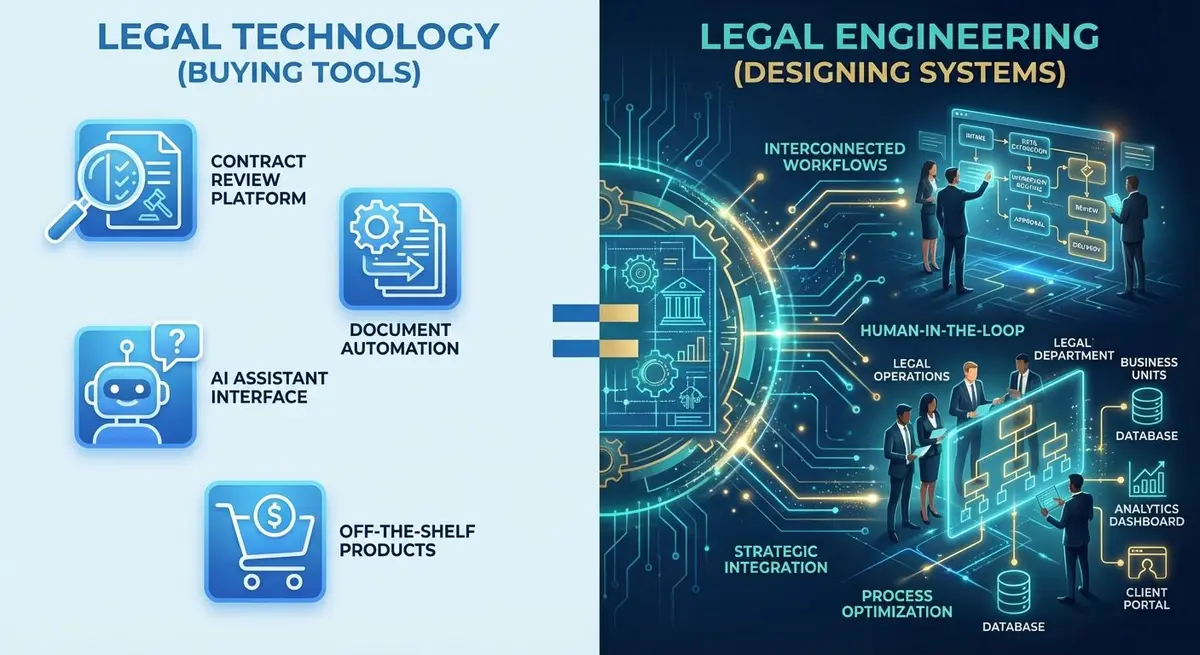
Legal Engineering Is Not Legal Technology
There is an important distinction that gets lost in the AI hype cycle, and it matters enormously for firms trying to navigate this transition.
Legal technology is a tool. It is the contract review platform, the document automation software, the AI research assistant. Every firm can buy it. It provides no lasting competitive advantage because your competitors have access to the same products.
Legal engineering is the discipline of designing workflows, systems, and organizational structures that integrate technology with human expertise to deliver legal services more effectively. It is the difference between handing a lawyer an AI tool and redesigning how the entire engagement lifecycle works from intake through delivery.
The 2026 Thomson Reuters/Georgetown State of the Legal Market report captured this tension perfectly. Law firms increased technology spending by nearly 10% in 2025 while simultaneously raising lawyer compensation by over 8%. Yet 90% of all legal revenue still flows through standard hourly billing. Firms are spending more to do work faster while still billing by the hour. That math does not hold up, and the report diplomatically describes the result as creating "an almost absurd tension."
Legal engineering resolves that tension. It starts with the question every firm should be asking: How do we restructure our delivery model so that AI-driven efficiency translates into client value and firm profitability simultaneously?

The Volume Trap: Why This Hits Some Firms Harder Than Others
Not every firm faces the same exposure to AI disruption, and the Baker McKenzie story illustrates why.
There are essentially two models operating at the top of the Am Law 100. High-RPL firms like Wachtell, Cravath, and Davis Polk generate massive revenue per lawyer through premium, high-stakes work that clients are willing to pay top dollar for regardless of efficiency gains. Their clients chose them for judgment, not for volume processing.
Then there are the global megafirms, including Baker McKenzie, DLA Piper, and Dentons, that built multi-billion dollar operations on geographic reach and volume. When your revenue model depends on thousands of lawyers handling cross-border compliance, due diligence, and regulatory work at scale, efficiency gains from AI cut directly into the business case for that headcount.
This is where legal operations strategy becomes critical. The firms that will thrive are not the ones cutting staff and hoping AI fills the void. They are the ones rethinking what their service delivery model looks like when a team of 50 can produce what previously required 150.
What Legal Ops Leaders Should Be Doing Right Now
The shift from AI experimentation to operational infrastructure is happening faster than most firms anticipated. According to a recent ACC/Everlaw survey, corporate legal AI adoption more than doubled in a single year, jumping from 23% to 52%. More importantly, 64% of in-house legal teams now expect to depend less on outside counsel because of AI capabilities they are building internally.
That statistic should be a five-alarm fire for every managing partner reading this. Your clients are not waiting for you to figure out your AI strategy. They are building their own.
For firms that want to stay ahead of this shift, three priorities stand out.
First, invest in workflow design before tool selection. The biggest surprise in legal AI, according to the National Law Review's survey of 85 legal professionals, will be how many AI pilot programs fail not because of model quality, but because firms underestimated governance, workflow design, and change management. Tools are only as effective as the processes they plug into.
Second, build pricing models that reward efficiency. Fixed-fee, value-based, and outcome-oriented pricing structures align the firm's interests with the client's. If your AI investments make you faster but you are still billing hourly, you are either padding hours (an ethics problem) or losing revenue (a business problem). Neither is sustainable.
Third, develop AI governance frameworks proactively. With the EU AI Act taking full effect for high-risk systems in August 2026, the Colorado AI Act launching in June, and ABA Formal Opinion 512 already establishing ethical requirements for AI competency, governance is no longer optional. Firms that treat it as a compliance checkbox rather than a strategic asset will find themselves managing crises instead of opportunities.
The Small Firm Advantage
Here is something the Baker McKenzie story obscures: AI is not just a big firm story. In many ways, the disruption creates the greatest opportunity for boutique and midsize firms.
The same Thomson Reuters report found that midsize firms surged ahead with nearly 5% demand growth in the second half of 2025 while the Am Law 100 struggled to crack 2%. Rate increases at top firms are pushing work downstream. When smaller firms leverage AI to deliver partner-level attention with enterprise-level capability at a fraction of BigLaw rates, they capture exactly the kind of mobile demand that is already reshaping the market.
This is the model we are building at FinTech Law: an AI-native practice where legal engineering is not an add-on but the foundation. Fixed-fee pricing. Streamlined onboarding. Technology infrastructure designed from the ground up to amplify attorney expertise rather than replace it. The goal is not to be a firm that uses AI. It is to be a firm that was built for the AI era.
Key Takeaways
- Baker McKenzie's 700+ staff cuts are a warning sign, not a playbook. Replacing headcount with AI without redesigning workflows is a recipe for the kind of overestimation that plagued Salesforce's agent rollout.
- Legal engineering, not legal technology, is the competitive differentiator. Any firm can buy tools. The advantage belongs to firms that redesign their delivery models around AI-augmented workflows.
- In-house teams are not waiting. With 64% of corporate legal departments expecting to reduce outside counsel reliance through AI, firms that cannot demonstrate both capability and transparency risk losing work permanently.
- Midsize and boutique firms have a structural advantage in this transition. Lower overhead, flexible pricing, and the ability to build AI-native from the start positions them to capture the demand flowing away from volume-dependent megafirms.
- AI governance is now a compliance obligation, not a best practice. Between the EU AI Act, state-level regulations, and ABA ethical guidance, firms need formal AI policies in 2026.
The Bottom Line
The Baker McKenzie layoffs are not the beginning of robots replacing lawyers. They are the beginning of a market correction where firms that invested in size and volume without investing in operational intelligence are finding that AI exposes the fragility of that model.
The firms that will define the next era of legal practice are not the ones with the most lawyers or the biggest AI budgets. They are the ones that understood, early enough, that legal engineering is not about the technology at all. It is about building a practice designed to deliver more value, more efficiently, with AI as an integral part of the architecture rather than an afterthought bolted onto a legacy business model.
If your firm is navigating AI integration, rethinking your service delivery model, or exploring how legal engineering can strengthen your competitive position, we would welcome the conversation.
Sources
- Above the Law - Baker McKenzie Massive Layoff - Coverage of Baker McKenzie's announcement of 700+ business services staff cuts attributed to AI.
- Thomson Reuters / Georgetown Law - 2026 State of the Legal Market Report - Annual report examining law firm performance, technology spending, and market trends.
- National Law Review - 85 Predictions for AI and the Law in 2026 - Survey of legal professionals on anticipated AI developments and challenges in the legal industry.
- American Bar Association - Formal Opinion 512 - ABA guidance on lawyers' ethical obligations regarding AI competency and use in legal practice.
External Source Links
- Above the Law: Baker McKenzie Massive Layoff
- Above the Law: Baker McKenzie AI Analysis
- Thomson Reuters / Georgetown 2026 State of the Legal Market
- National Law Review: 85 Predictions for AI and the Law in 2026
- ABA Formal Opinion 512