EU AI Act Overhaul: Deadlines Extended, Nudifier Apps Banned by December 2026
The EU Just Rewrote Its AI Compliance Calendar — And Not in the Direction You Think
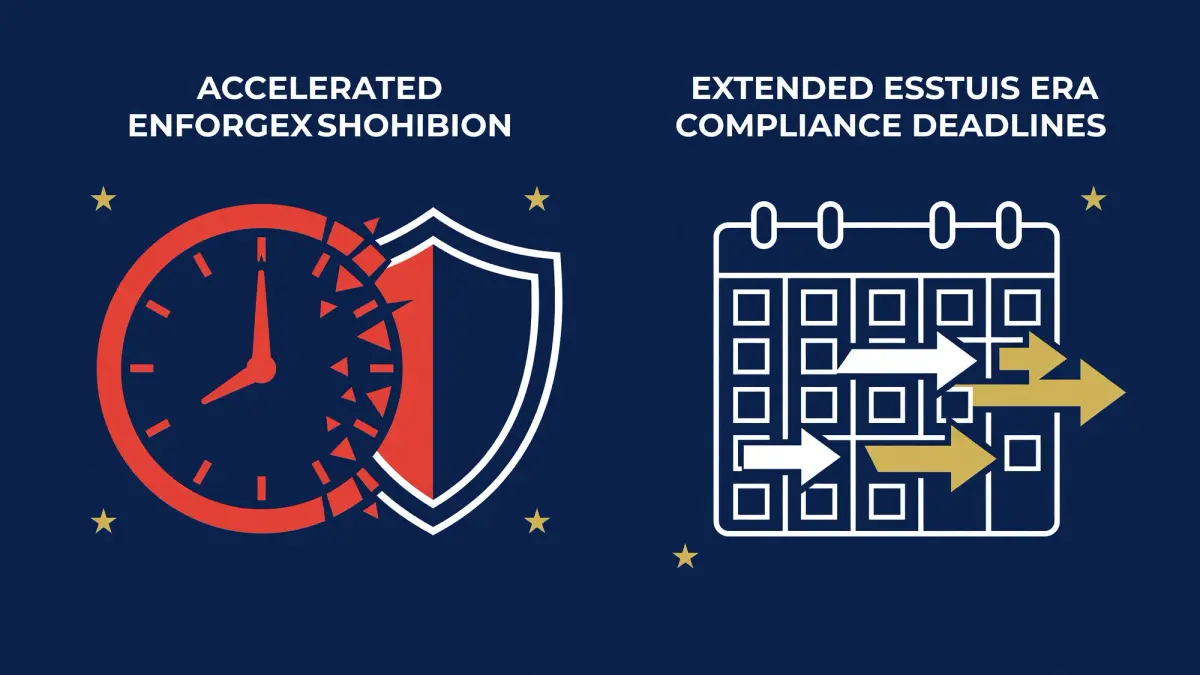
On May 7, 2026, the European Parliament and Council of the EU reached a provisional political agreement on the Digital Omnibus on AI, a package that amends the EU AI Act (Regulation 2024/1689) in two directions at once. High-risk AI compliance deadlines are being pushed back by more than a year. At the same time, a new prohibition on so-called nudifier apps — AI systems that generate or manipulate non-consensual intimate imagery — is being accelerated, with that ban taking effect on December 2, 2026.
But here is the part most coverage is missing. The EU is not simply hitting pause on AI regulation. It is making a deliberate governance choice: tighten the rules on harmful AI faster than it enforces rules on beneficial AI. That asymmetry carries real consequences for every company deploying AI systems in or into Europe, whether the product is a hiring tool, a credit-scoring model, or a consumer-facing generative application.
Here is what happened, why it matters, and what your compliance calendar needs to reflect right now.
What the Digital Omnibus on AI Actually Changes
The European Commission published the Digital Omnibus on AI proposal on November 19, 2025, and the May 7 provisional agreement reflects the outcome of trilogue negotiations. Two categories of change define the deal.
Deadline Extensions for High-Risk AI
The agreement postpones two major compliance cliffs:
- Annex III (use-based high-risk systems): Obligations move from August 2, 2026 to December 2, 2027 — a 16-month extension. Annex III covers AI systems used in employment, education, credit, law enforcement, and similar high-stakes contexts.
- Annex I (AI embedded in regulated products): Obligations move from August 2, 2027 to August 2, 2028 — a 12-month extension. Annex I covers AI integrated into medical devices, machinery, and other product-regulated categories.
The stated rationale is simplification and burden reduction for smaller operators. The practical effect is that companies racing to meet the August 2026 Annex III deadline now have until December 2027 — but only if formal adoption completes before August 2, 2026.
New Prohibition: Nudifier Apps
The agreement adds a new prohibited AI practice targeting systems that generate or manipulate images, video, or audio to depict real individuals in non-consensual intimate scenarios. The ban takes effect on December 2, 2026. Violations fall under Article 99 of the AI Act, which subjects non-compliant operators to administrative fines of up to €35 million or 7% of total worldwide annual turnover, whichever is higher.
Watermarking Obligations
The application of watermarking obligations on AI-generated content is set for December 2, 2026 — moved earlier than the Commission's original February 2027 proposal. Companies deploying generative AI tools that produce synthetic media need to treat December 2, 2026 as a hard deadline for both the nudifier prohibition and content provenance labeling.
The Governance Signal Hidden in the Asymmetry
Read the two sets of changes together and a clear regulatory philosophy emerges. The EU is willing to give industry more time to build compliant high-risk AI infrastructure. It is not willing to give industry more time to stop building tools that cause direct harm to individuals.
This is not a contradiction. It is a deliberate prioritization. The nudifier ban and the watermarking deadline both land on December 2, 2026. The Annex III high-risk deadline does not arrive until December 2, 2027. The message is unmistakable: consumer protection from AI-enabled harm is non-negotiable on the original schedule, while compliance infrastructure for beneficial AI gets more runway.
For AI governance purposes, this asymmetry should reshape how companies sequence their EU compliance programs. A company that deprioritized the nudifier question because it seemed peripheral to its core product may be surprised to find that the prohibition is broader than the name suggests. The agreement covers any AI system that generates or manipulates non-consensual intimate imagery — a definition that could reach certain image-editing APIs, avatar generation tools, or synthetic media pipelines depending on how the final text is interpreted.
The precise scope of exceptions for systems with "effective safety measures" has not yet been detailed in public sources. Companies operating in adjacent product categories should not assume they fall outside the prohibition without a careful review of the final adopted text once it appears in the Official Journal.
What the Provisional Agreement Is — and Is Not — as of Today
This is a critical distinction that several commentators are blurring. The May 7 agreement is a provisional political agreement. It is not enacted law.
Formal adoption requires a Parliament plenary vote and a Council formal adoption vote. The co-legislators intend to complete both before August 2, 2026, with publication in the Official Journal expected by July 2026. As of June 14, 2026, those votes have not yet occurred. The full legal text has not been published.
For compliance planning, this creates a narrow but real window of uncertainty. Companies that were building toward the August 2, 2026 Annex III deadline should not stand down entirely on the assumption that the extension will be formalized. The extension only takes effect if formal adoption completes before August 2, 2026. If that timeline slips — which is unlikely but possible — the original deadline would remain operative.
The prudent posture is to continue Annex III compliance work at a measured pace while monitoring the Official Journal for formal publication. Do not treat the 16-month extension as a reason to restart the compliance clock from zero.
Specific Actions for Companies Operating in or Selling into the EU
The Digital Omnibus on AI changes the compliance calendar but does not eliminate the underlying obligations. Here is what warrants immediate attention.
For Companies with Annex III High-Risk AI Systems
- Do not abandon August 2026 readiness work. Formal adoption must complete before August 2, 2026 for the extension to apply. Continue documentation, conformity assessment preparation, and risk management system development.
- Replan your roadmap for December 2, 2027. Use the additional runway to build compliant systems properly rather than rushing a minimum viable compliance posture.
- Audit your Annex III classification. The extension applies to use-based high-risk systems. Confirm which of your AI systems fall under Annex III categories — employment screening, creditworthiness assessment, biometric categorization — and which do not.
For Companies with Generative AI Products
- Treat December 2, 2026 as a hard deadline for two obligations: the nudifier prohibition and watermarking of AI-generated content. Both land on the same date.
- Review your product's synthetic media capabilities. If your platform can generate or manipulate images or video of real individuals, assess whether the nudifier prohibition applies and what technical controls are required.
- Do not rely on the "effective safety measures" exception until the final adopted text defines what qualifies. The provisional agreement references this carve-out but public sources do not yet detail its scope.
For Annex I (Regulated Product) Companies
- The new deadline is August 2, 2028. AI embedded in medical devices, machinery, and other product-regulated categories has an additional 12 months beyond the prior deadline. Use that time to align AI Act conformity assessment with existing product regulatory cycles rather than running parallel tracks.
Key Takeaways
- The nudifier ban is not a niche provision — it carries €35 million penalties. Any AI system that generates or manipulates non-consensual intimate imagery is prohibited as of December 2, 2026, with fines reaching 7% of global annual turnover under Article 99 of the AI Act.
- The Annex III extension is conditional, not guaranteed. High-risk AI obligations for use-based systems move to December 2, 2027 only if formal adoption completes before August 2, 2026 — a vote that had not yet occurred as of June 14, 2026.
- The EU is enforcing harm-prevention faster than compliance infrastructure. The December 2, 2026 dates for the nudifier ban and watermarking obligations arrive a full year before the Annex III high-risk deadline. That sequencing is intentional and reflects the EU's AI governance priorities.
- Annex I companies gain 12 additional months. AI embedded in regulated products now has until August 2, 2028, giving product manufacturers time to integrate AI Act conformity assessment into existing regulatory cycles.
- The final legal text is not yet published. Compliance decisions should be based on the provisional agreement press releases and the Official Journal publication once available — not on secondary summaries, including this one.
The Real Question Is Not Whether to Comply — It Is When and How
The Digital Omnibus on AI does not reduce the EU's ambition for AI regulation. It recalibrates the timeline while hardening the rules that matter most to regulators right now: preventing AI-enabled harm to individuals. Companies that read the deadline extensions as a signal to deprioritize EU AI compliance are misreading the agreement.
The real question is not whether your AI systems will need to meet these obligations. They will. The question is whether you use the additional runway to build a durable compliance program or to delay until the next deadline crisis.
FinTech Law helps AI companies, fintech platforms, and technology-forward businesses structure their AI governance programs for both US and EU regulatory requirements. If your company is assessing how the Digital Omnibus on AI affects your product roadmap or compliance obligations, we would welcome the conversation. Contact us to schedule a consultation.
---
*This blog post is for informational purposes only and does not constitute legal advice. No attorney-client relationship is formed by reading this content. If you need legal advice, please contact a qualified attorney.*