The SEC's New Crypto Playbook: Five Categories Every Founder Needs to Know
After more than a decade of regulatory ambiguity, the SEC has finally drawn the lines. On March 17, 2026, the Commission issued its most comprehensive interpretive release to date — Release Nos. 33-11412 and 34-105020 — establishing a five-part taxonomy for crypto assets under the federal securities laws. The CFTC joined the release, creating the first coordinated federal framework for determining whether your token is a security, a commodity, or something else entirely.
If you are building in crypto, raising capital through token sales, or advising projects that are, this release demands your immediate attention. Here is what it means for you — and the concrete steps you should take now.
The Five Categories: Where Does Your Token Fall?
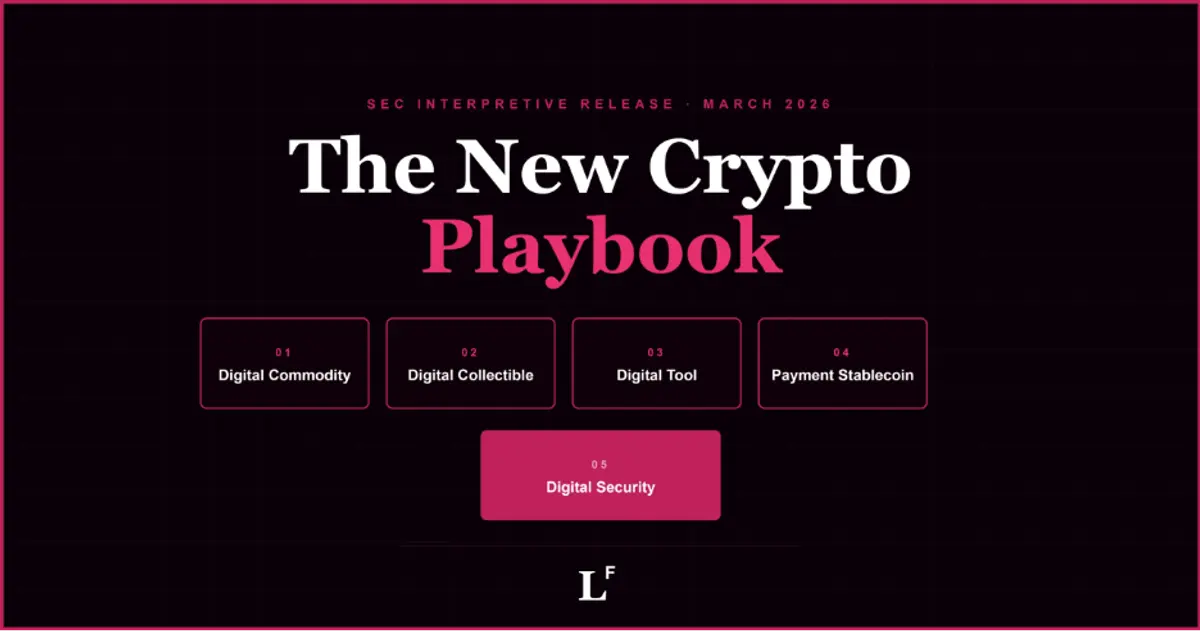
The interpretive release classifies crypto assets into five distinct categories, each with different regulatory consequences:
- Digital Commodities. Assets intrinsically linked to the programmatic operation of a functional crypto system — think Bitcoin, Ethereum, Solana, and XRP. Their value derives from network functionality and supply-and-demand dynamics, not from the managerial efforts of a promoter. These are not securities under the release and fall under CFTC jurisdiction for spot market oversight.
- Digital Collectibles. NFTs, meme coins, and assets designed primarily for collection, personal use, or expressive purposes. These are generally not securities — but fractionalization, revenue-sharing arrangements, or other structures that introduce profit expectations from a promoter's efforts can push them into investment contract territory.
- Digital Tools. Tokens that function as memberships, credentials, tickets, title instruments, or identity badges — consumed or used rather than held as investments. Not securities under the release.
- Payment Stablecoins. Stablecoins meeting the definition of "permitted payment stablecoin issuer" under the GENIUS Act are excluded from the securities definition by statute. Other stablecoins remain subject to a facts-and-circumstances analysis. The OCC's February 2026 proposed rulemaking establishes the supervisory framework for these issuers.
- Digital Securities. Tokenized stocks, bonds, ETFs, or other financial instruments that fall squarely within the statutory definition of "security" — regardless of whether they live on a blockchain. These remain fully subject to SEC registration, disclosure, and exchange requirements.
The Investment Contract Question Is Not Going Away
Here is the critical nuance that many summaries of this release miss: a token that falls into one of the non-security categories can still become a security if it is offered and sold as part of an investment contract.
The Commission applies the familiar Howey test, but with new specificity. Whether a token sale creates an investment contract now turns heavily on the issuer's representations or promises — their specificity, how they are communicated, and whether purchasers can reasonably rely on them. Vague statements about a project's potential are less likely to create an investment contract than detailed roadmaps with milestones, funding plans, and specific deliverables.
Importantly, the release also clarifies when a token exits investment contract status. If an issuer has fulfilled the developmental promises it made — or publicly abandoned them — secondary market transactions in that token may no longer constitute securities transactions. This is significant for projects approaching network maturity.
What the Release Says About Common Activities
The Commission addressed several activities that have been regulatory gray areas for years. Protocol mining and staking (across all four staking models — solo, self-custodial, custodial, and liquid) are generally not securities transactions when rewards are determined by protocol rules rather than managerial discretion. Staking receipt tokens for non-security crypto assets, wrapping of non-security tokens into one-for-one redeemable representations, and no-consideration airdrops similarly fall outside the securities laws in the circumstances described.
This clarity is welcome, but note the qualifier: these conclusions apply to the specific fact patterns described. Staking-as-a-service models with discretionary management, or airdrops that require quid pro quo actions, may reach different results.
Coming Next: Regulation Crypto Assets
Chairman Atkins previewed a forthcoming rulemaking framework called "Regulation Crypto Assets" at the Digital Chamber's Blockchain Summit. Drawing on Commissioner Peirce's Token Safe Harbor proposal, this framework contemplates a startup exemption that could allow early-stage projects to raise up to approximately $5 million over a four-year period with principles-based disclosures and notice filings. A broader fundraising exemption and potential safe harbor provisions are also under development.
This is not law yet — it is a roadmap. But it signals the Commission's intent to create viable pathways for compliant token offerings that do not require full Securities Act registration.
Five Steps Every Crypto Founder Should Take Now
- Classify your token. Map your asset against the five-category taxonomy. If you are in the digital commodities, collectibles, or tools bucket, document the factual basis for that classification now.
- Audit your representations. Review every white paper, pitch deck, website, social media post, and Discord announcement. The investment contract analysis now turns on what you promised and how specifically you promised it. Vague aspirational language is your friend; detailed performance commitments tied to your team's efforts are not.
- Plan your exit from investment contract status. If your token was sold with specific developmental promises, define clear milestones that demonstrate fulfillment. Publicly disclose when those milestones are met. The release gives you a path out of securities treatment — but only if you can demonstrate completion.
- Review staking and airdrop structures. Confirm that your staking rewards are protocol-determined, not discretionary. Ensure airdrops do not require consideration that could trigger Howey.
- Watch for Regulation Crypto Assets. The proposed startup and fundraising exemptions could meaningfully change your capital formation strategy. Engage with the comment process (File No. S7-2026-09) and prepare to adapt.
Key Takeaways
- The SEC's March 2026 interpretive release establishes five categories of crypto assets — four of which are generally not securities — replacing years of enforcement-driven uncertainty with official Commission-level guidance.
- The CFTC joined the release, confirming coordinated federal oversight and establishing that digital commodities fall under CFTC rather than SEC jurisdiction.
- Non-security tokens can still become securities through investment contracts — and the analysis now centers on issuer representations, their specificity, and their communication channels.
- Tokens can exit investment contract status when issuers fulfill or publicly abandon their developmental promises.
- Chairman Atkins' proposed "Regulation Crypto Assets" framework signals forthcoming startup exemptions, fundraising exemptions, and safe harbor provisions for compliant token offerings.
What This Means for Your Business
This interpretive release is a genuine inflection point — but it is not a free pass. The taxonomy provides the clearest framework the industry has ever received, yet the fact-specific nature of the Howey analysis means your classification is only as strong as the factual record supporting it.
Need help classifying your crypto asset or structuring a compliant token offering under the new SEC framework? Contact FinTech Law for a consultation.
Disclaimer: This blog post is for informational purposes only and does not constitute legal advice. The application of securities laws to crypto assets depends on specific facts and circumstances. Consult qualified legal counsel for guidance on your particular situation.