The SEC's Enforcement Reset: What the FY2025 Results Mean for Fintech and Digital Asset Firms
The SEC Just Reset Its Enforcement Playbook
On April 7, 2026, the SEC released its enforcement results for fiscal year 2025 — and the numbers tell only part of the story. The more significant development is what Chairman Paul S. Atkins said about them: the prior Commission's approach was a misallocation of resources, a bias toward volume over investor protection, and in some cases, a misinterpretation of the federal securities laws.
That is a sitting SEC Chairman repudiating his predecessor's enforcement program on the record. For fintech startups, digital asset firms, and investment advisers, understanding what changed — and what didn't — is essential.
What the Numbers Say
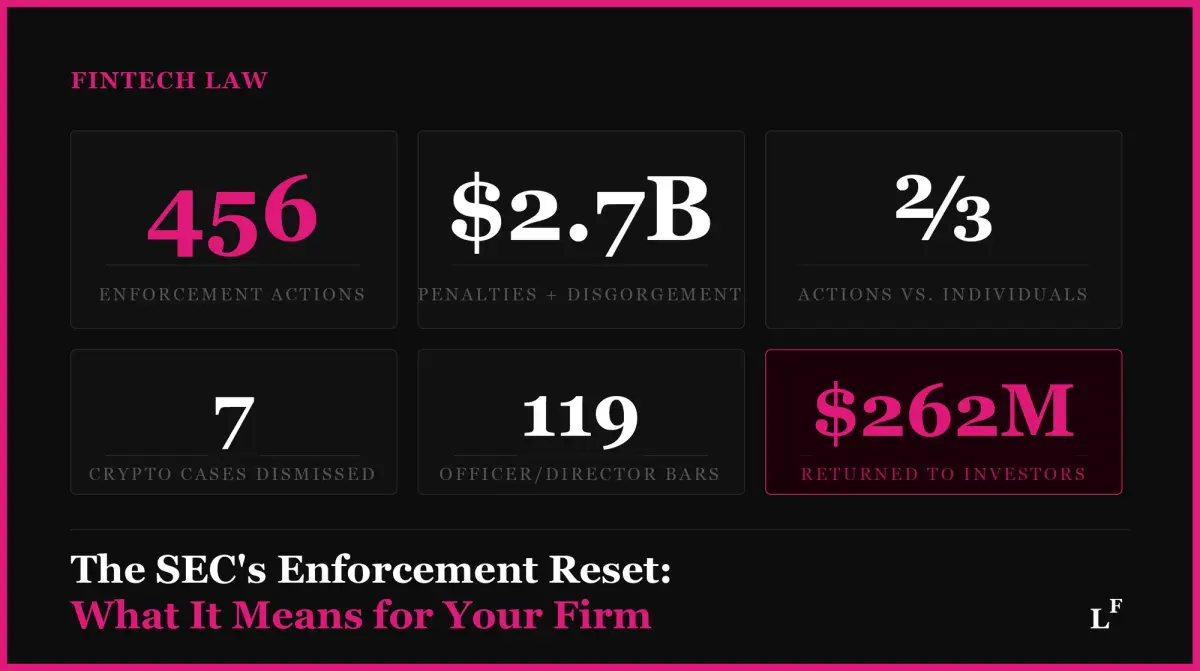
The Commission filed 456 enforcement actions in FY2025, including 303 standalone actions, and obtained orders for monetary relief totaling $17.9 billion. But that headline figure requires context. After excluding amounts deemed satisfied by parallel criminal proceedings and the long-running Stanford Ponzi scheme litigation, the monetary relief totaled $1.4 billion in disgorgement and $1.3 billion in civil penalties — a significantly different picture than the top-line number suggests.
Other notable results: approximately $262 million was returned to harmed investors, approximately $60 million was awarded to 48 individual whistleblowers, and the SEC received a record 53,753 tips, complaints, and referrals — nearly 19% more than the prior fiscal year. Of standalone actions filed, approximately two-thirds involved charges against one or more individual bad actors, a 27% year-over-year increase.
The Policy Shift: From Volume to Fraud
The core message of the FY2025 report is a deliberate reorientation of enforcement priorities. Chairman Atkins identified three categories of prior enforcement activity the current Commission views as misguided:
- Off-channel communications cases. Since FY2022, the prior Commission brought 95 actions and $2.3 billion in penalties against firms for failing to maintain and preserve off-channel communications. The current Commission's view: these cases identified no direct investor harm, produced no investor benefit, and represent a misinterpretation of federal securities laws.
- Crypto firm registration cases. Seven enforcement actions brought against crypto firms under registration-related theories have been dismissed since February 2025, including actions against Coinbase, Binance, Consensys, and Cumberland DRW. The current Commission views these as enforcement-driven policymaking rather than investor protection.
- "Definition of a dealer" cases. Six cases brought under a novel and contested legal theory that the prior Commission pursued aggressively have also been characterized as a misallocation of resources.
Going forward, enforcement will be concentrated on fraud, market manipulation, insider trading, issuer disclosure violations, and breaches of fiduciary duty — cases that, as Chairman Atkins noted, "provide meaningful investor protection and strengthen market integrity."
What This Means for Digital Asset Firms
The dismissal of seven crypto enforcement actions and the explicit repudiation of registration-based theories are significant developments — but they do not signal a compliance reprieve. The current Commission has made equally clear that it will pursue fraud, manipulation, and deceptive conduct in crypto markets aggressively. The FY2025 results include enforcement actions against Unicoin Inc. and four executives for false and misleading statements in a token offering, and against PGI Global founder Ramil Palafox for a $198 million crypto fraud scheme.
The enforcement posture has shifted from "are you registered?" to "are you defrauding investors?" For digital asset firms, this means:
- Token offerings require honest disclosure. The current Commission is not pursuing novel registration theories, but it is pursuing fraud. False or misleading statements in connection with token offerings — in white papers, marketing materials, or investor presentations — remain high-risk regardless of whether the token is classified as a security.
- Individual accountability is a priority. Nearly two-thirds of standalone actions involved charges against individuals, and the Commission obtained 119 officer and director bars. Founders and executives who are personally involved in misconduct are squarely in scope.
- The crypto task force is active. The Cyber and Emerging Technologies Unit, launched in February 2025, is specifically focused on blockchain technology, AI, and emerging technology fraud. The enforcement infrastructure for digital asset cases has not been dismantled — it has been refocused.
What This Means for Investment Advisers
The FY2025 results include several actions directly relevant to registered investment advisers. A $150,000 enforcement action against FamilyWealth Advisers for hedge clause language and assignment provisions in advisory agreements — highlighted in our earlier analysis — is part of a broader pattern of fiduciary duty enforcement that continues under the current Commission.
The FY2025 results also include an action against Vanguard Advisers for failing to adequately disclose conflicts of interest when recommending a fee-based advisory service. The Commission's message is consistent: the shift away from off-channel communications penalties and novel legal theories does not signal reduced scrutiny of fiduciary obligations. Conflicts of interest, disclosure failures, and breaches of trust remain enforcement priorities.
Advisers should note the continued emphasis on self-reporting and cooperation. In FY2025, firms that self-reported violations, cooperated meaningfully, or remediated securities law violations received reduced civil penalties or had enforcement actions declined entirely. The Commission has made clear this pathway remains available and actively encourages its use.
Key Takeaways
- The enforcement reset is real — and it has sharp edges. The current Commission has stepped back from off-channel communications penalties, novel registration theories, and dealer definition cases. It has not stepped back from fraud, manipulation, individual accountability, or fiduciary duty enforcement.
- For digital asset firms: The relevant question is no longer primarily "is my token a security?" It is "are my disclosures accurate and complete?" Offering fraud in crypto markets is the current Commission's highest priority in the digital asset space.
- For investment advisers: Fiduciary duty enforcement — conflicts of interest, inadequate disclosure, breaches of trust — remains squarely in scope. The FamilyWealth advisory agreement action and the Vanguard conflict of interest action are the current enforcement roadmap.
- Individual accountability has increased. Two-thirds of standalone actions involve individual charges. Founders and executives are personally exposed for misconduct that occurs on their watch.
- Self-reporting and cooperation are rewarded. Firms that identify issues, report them, and remediate are receiving meaningfully better outcomes. Building a compliance culture that surfaces problems early is not just good practice — it is now an explicit factor in the Commission's enforcement calculus.
FinTech Law works with fintech startups, digital asset companies, and investment advisers to build compliance programs that reflect the enforcement environment that exists — not the one that existed two years ago. If your firm's compliance posture was built around the prior Commission's priorities and hasn't been updated, the FY2025 results are a signal that the update is overdue.
Contact FinTech Law for a consultation and subscribe to our newsletter for ongoing analysis as the SEC's enforcement priorities continue to evolve.
Disclaimer: This content is provided for general informational purposes only and does not constitute legal advice. The information contained herein reflects publicly available information and general legal commentary as of the date of publication. Fintech founders and businesses should consult with qualified legal counsel regarding their specific circumstances before making any compliance or business decisions. FinTech Law LLC does not guarantee the accuracy, completeness, or timeliness of any information contained in this post.