SEC Report Shows Private Markets Dominate Capital Raising

The SEC's Office of the Advocate for Small Business Capital Formation just released its 2025 annual report to Congress, and the data tells a compelling story: private markets aren't just holding steady—they're running away with the game.
For fund managers and emerging companies weighing their capital-raising options, this report provides critical intelligence. Combined with Paul Atkins' confirmation as SEC Chairman, we're entering a period where the rules of capital formation may shift meaningfully in your favor.
Here's what the numbers reveal and what it means for your next raise.
Private Offerings Raise Twice as Much as Public Markets
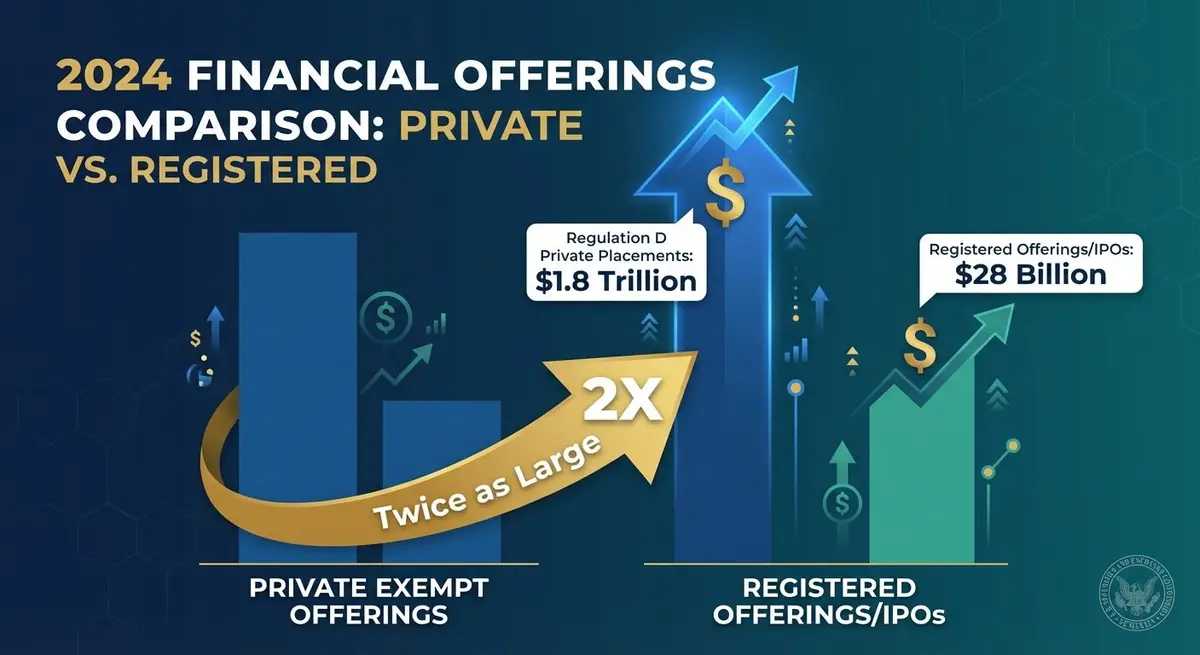
The headline finding won't surprise practitioners in the private capital space, but the magnitude is striking. In fiscal year 2024, exempt offerings raised approximately twice as much capital as registered offerings.
Rule 506(b) private placements alone accounted for $1.8 trillion—dwarfing the $28 billion raised through IPOs. Even the much-discussed Regulation Crowdfunding represented just $249 million, barely registering against the Regulation D juggernaut.
The message is clear: if you're raising capital from accredited investors through Regulation D, you're using the same pathway that facilitates the vast majority of private capital in America. That's not a second-choice option—it's the dominant strategy.

Why Small Companies Are Staying Private
The report documents a continued decline in small public companies, those with market capitalizations under $250 million. Three factors drive this trend.
First, private capital abundance means companies can achieve substantial scale without accessing public markets. When your Series B can exceed what an IPO might have raised a decade ago, the calculus changes.
Second, acquisition activity continues absorbing promising companies before they reach public-ready scale. Strategic buyers and private equity increasingly intercept companies on the path to IPO.
Third, and perhaps most actionable, the cost burden of going public remains substantial. The report quantifies incremental annual costs of maintaining public company status at approximately $526,000—including enhanced disclosure requirements ($36,000), SOX 404 compliance ($129,000), and governance requirements ($361,000).
For companies evaluating their long-term capital strategy, that half-million-dollar annual price tag deserves careful consideration.
VC Concentration Creates Opportunity for Emerging Managers
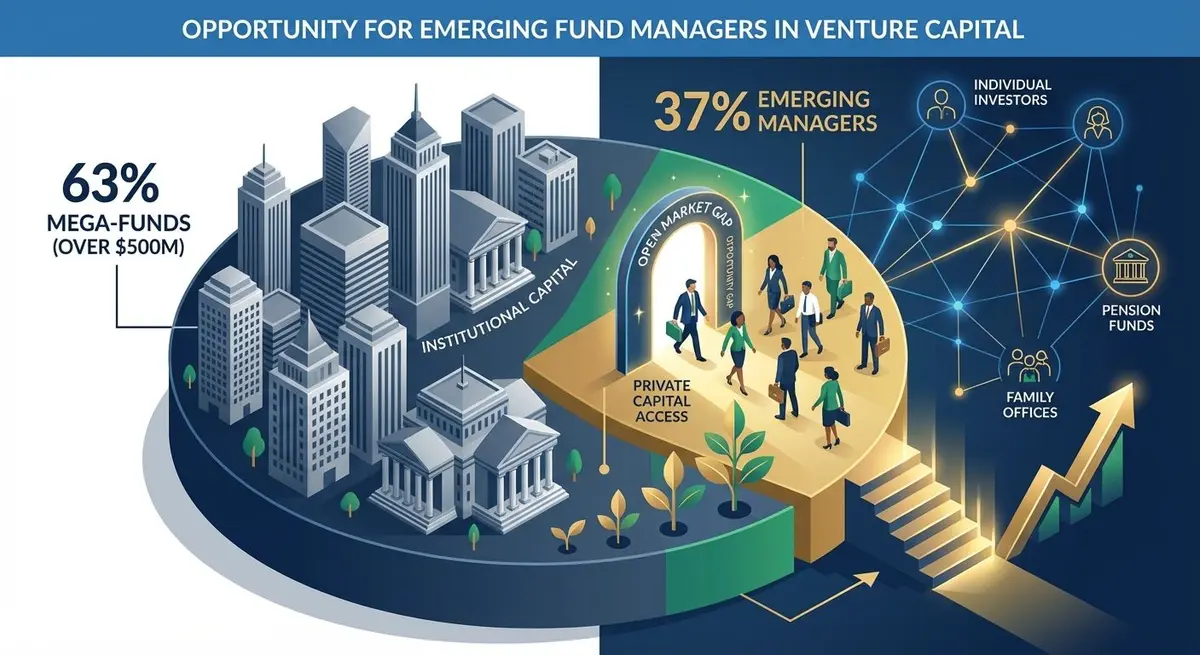
The venture capital landscape shows an interesting bifurcation that emerging fund managers should note. While overall deal activity has recovered from 2023 lows, 63% of VC capital now concentrates in funds exceeding $500 million in assets.
This concentration creates a meaningful market gap. Institutional and individual investors seeking diversification beyond mega-funds are actively searching for smaller, specialized managers with focused strategies.
If you're an emerging manager frustrated by the perception that "all the capital goes to the big players," the data suggests otherwise. The concentration at the top leaves a substantial portion of the market underserved—and looking for alternatives like you.

What to Expect Under Chairman Atkins
Paul Atkins' confirmation as SEC Chairman signals a regulatory philosophy shift toward capital formation. Based on public statements and Advisory Committee recommendations, several areas merit attention.
Accredited investor definitions may see revision, potentially including alternative pathways to accreditation through investor education programs rather than pure income and net worth thresholds.
Regulation D modernization could streamline Form D filing requirements, Rule 506(c) verification procedures, and integration rules across multiple offerings.
Emerging fund manager support remains on the agenda, including potential increases to the 100 beneficial owner limit under Section 3(c)(1) and expansion of the qualifying venture capital fund exemption beyond its current $12 million limit.
For fund managers approaching structural limits or frustrated by verification burdens, relief may be coming. Position your documentation and compliance procedures to take advantage when rules change.
Don't Overlook Regulation A
While Regulation D dominates, Regulation A raised $1.5 billion in fiscal year 2024 and may deserve a second look for the right situation.
Tier 2 Regulation A offers up to $75 million in a 12-month period with blue sky preemption, testing-the-waters provisions, and lighter ongoing reporting than full Exchange Act requirements. For companies seeking broad investor participation without full public company burdens, it represents a legitimate middle path.
Commissioner Uyeda has publicly noted that Regulation A "might be a third way" between registered and exempt offerings. If your capital needs fall in the $20-75 million range and you want participation from non-accredited investors, evaluate whether Regulation A fits your strategy.
Key Takeaways
- Regulation D remains dominant: Private placements raised $1.8 trillion versus $28 billion in IPOs—structure accordingly
- Going public costs approximately $526,000 annually in incremental compliance costs—factor this into long-term planning
- VC concentration creates opportunity: 63% of capital in mega-funds leaves substantial market space for specialized emerging managers
- Regulatory relief may be coming: Chairman Atkins' priorities suggest potential modernization of accredited investor definitions and Regulation D requirements
- Monitor Q2 2026: The regulatory agenda will clarify SEC priorities and timing for potential reforms
Position Your Next Raise for Success
The private capital markets have never been more active, and regulatory tailwinds may strengthen in the coming year. Whether you're structuring a fund, planning an exempt offering, or evaluating your long-term capital strategy, the data supports proactive positioning now.
Need help navigating these developments? Contact FinTech Law to discuss how the evolving regulatory landscape affects your specific situation.
Source: SEC Office of the Advocate for Small Business Capital Formation, 2025 Staff Report
Disclaimer: This post is for informational purposes only and does not constitute legal advice. Please consult qualified counsel regarding your specific circumstances.