SEC and CFTC Joint Harmonization Event: What Fintech Founders Need to Know
A Historic Step Toward Regulatory Clarity
For years, one of the most persistent pain points for fintech startups and crypto founders has been a simple but costly question: Is my product regulated by the SEC, the CFTC, or both? That question now has a clearer answer than ever.
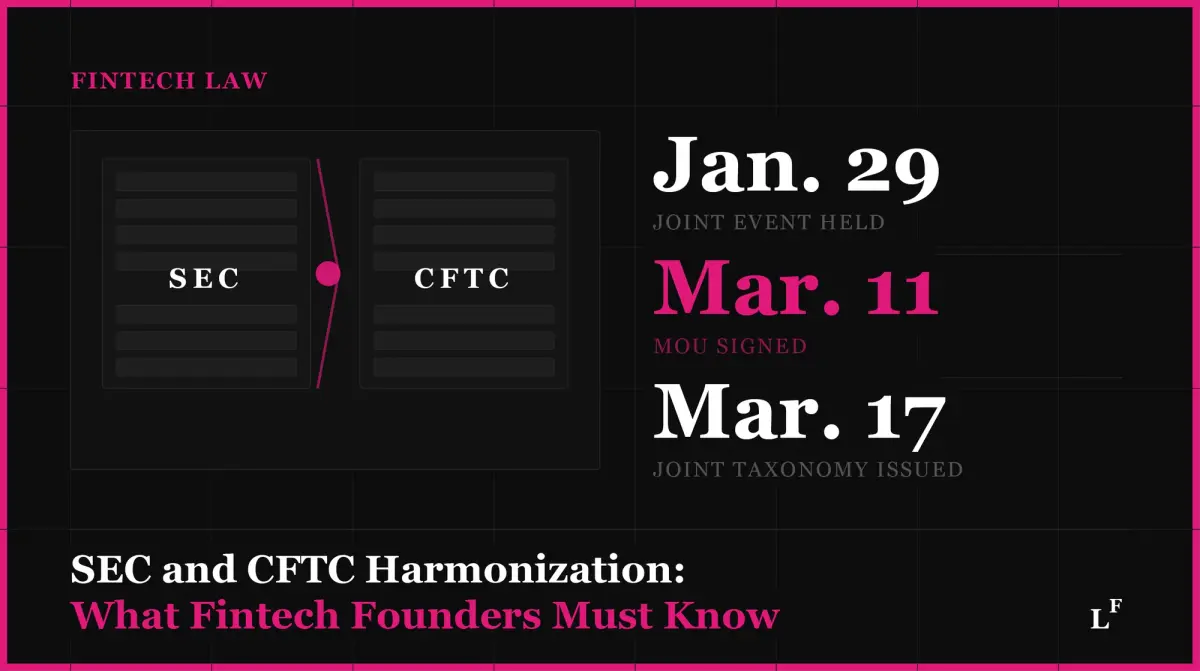
On January 29, 2026, SEC Chairman Paul S. Atkins and CFTC Chairman Michael S. Selig held a joint event at CFTC headquarters formally launching Project Crypto as a joint initiative — the most ambitious coordination effort between the two agencies in a generation. Then on March 11, the agencies signed a landmark Memorandum of Understanding formalizing information sharing, surveillance coordination, and supervisory cooperation. Six days later, on March 17, the SEC issued a comprehensive interpretive release — Release Nos. 33-11412 and 34-105020 — establishing a five-part taxonomy for crypto assets under federal securities law, which the CFTC jointly endorsed.
If you’re building in crypto, raising capital through token sales, or advising projects that are, read on.
Why the SEC-CFTC Jurisdictional Overlap Has Been a Problem
The tension between the SEC and CFTC over digital asset jurisdiction is not new. The SEC has historically asserted that most cryptocurrencies and digital tokens qualify as securities under the Howey Test, subjecting them to registration requirements and enforcement actions. The CFTC has classified Bitcoin and Ether as commodities, placing them within their own regulatory framework.
For fintech startups, this overlap has created a compliance nightmare. A single product — a tokenized asset, a crypto derivatives platform — could theoretically trigger obligations under both agencies simultaneously. Founders have had to hire multiple legal teams, navigate conflicting guidance, and make high-stakes judgment calls with incomplete information. Chairman Atkins acknowledged this directly at the January event, describing the legacy of "turf war" dynamics and calling fragmented oversight "not a safeguard for investors so much as a source of confusion." (SEC.gov, Jan 29, 2026)
What the MOU and Joint Interpretive Release Actually Do
The March 11 MOU commits the agencies to six core areas of coordination: issuing joint interpretations and rulemakings to clarify product definitions, modernizing frameworks for clearing and collateral, reducing frictions for dually registered exchanges and intermediaries, ending duplicative examinations, coordinating enforcement before filing parallel actions, and facilitating a path for "super-apps" — unified financial platforms that allow users to access traditional securities, derivatives, crypto assets, and banking services under a coordinated compliance framework. (Latham & Watkins, March 20, 2026)
The agencies have also launched a Joint Harmonization Initiative website where market participants can submit written input or request coordinated meetings with SEC and CFTC staff.
The March 17 interpretive release goes further, establishing a definitive token taxonomy — five categories with immediate practical consequences for how founders structure their products and capital raises (see our recent blog post on this topic).
What Harmonization Could Mean for Your Startup
If the SEC and CFTC move toward a fully harmonized framework — as the MOU and Project Crypto initiative envision — the practical implications for fintech founders could be significant.
Clearer jurisdictional lines would reduce the cost and complexity of startup legal compliance. Founders would have a more definitive answer about which agency they report to, what registration or licensing requirements apply, and how to structure products to stay compliant.
Reduced dual enforcement risk would provide more predictable outcomes. Coordinated enforcement has been a core commitment of the MOU — the agencies have agreed to confer on potential charges before filing parallel actions.
Accelerated institutional adoption of tokenization and digital assets by giving banks, asset managers, and other regulated entities the regulatory certainty they need to participate. BlackRock CEO Larry Fink argued in his March 2026 shareholder letter that digital assets and tokenization could "update the plumbing of the financial system" — and institutional players like Franklin Templeton and Invesco are already acting on that view. (CoinDesk, March 25, 2026)
Key Compliance Areas to Watch
Even with the new taxonomy in place, founders should be proactively reviewing several areas.
Token classification. Map your asset against the five-category taxonomy. If you are in the digital commodities, collectibles, or tools bucket, document the factual basis for that classification now — before a regulator or plaintiff forces the analysis.
Your representations. Review every white paper, pitch deck, website post, and Discord announcement. The investment contract analysis now turns on what you promised and how specifically you promised it. Vague aspirational language is your friend; detailed performance commitments tied to your team's efforts are not.
Money transmitter licensing. Harmonization at the federal level does not eliminate state-level money transmitter license obligations. Depending on your product, you may need licenses in multiple states.
Terms of service and privacy policy. These documents need to accurately reflect your regulatory status and obligations. As the framework shifts, foundational legal documents must keep pace. AI legal tech tools are increasingly being used to help fintech startups monitor regulatory changes and flag compliance gaps in real time — a capability that will become even more valuable as harmonization discussions evolve.
Staking and airdrop structures. The interpretive release clarifies that protocol-determined staking rewards and no-consideration airdrops generally fall outside the securities laws — but discretionary staking-as-a-service models or airdrops requiring quid pro quo actions may reach different results.
The Bigger Picture: U.S. Financial Leadership in the Crypto Era
The framing of this joint event — U.S. financial leadership in the crypto era — is itself a meaningful signal. It suggests that both agencies are approaching this moment not just as a compliance exercise, but as a strategic opportunity to position the United States as the global standard-setter for digital asset regulation.
For fintech founders, this is an important context. A more coherent U.S. regulatory framework could make it easier to attract foreign investment, expand into international markets, and compete with crypto-friendly jurisdictions that have moved faster on regulatory clarity. It also suggests both the SEC and CFTC are aware that overly aggressive or fragmented enforcement could push innovation offshore — a dynamic that has already played out in some segments of the industry. Founders who engage proactively with the regulatory process, submit comments during public rulemaking periods, and build compliance into their products from day one will be better positioned to thrive in whatever framework emerges.
What Fintech Founders Should Do Right Now
You don’t need to wait for a final harmonization framework to take action. Here are practical steps fintech founders can take today.
- Stay informed by monitoring official communications from both the SEC and CFTC following this joint event. Both agencies publish guidance, speeches, and rulemaking notices that can provide early signals about regulatory direction.
- Conduct a compliance audit of your current product, focusing on how it would be classified under both SEC and CFTC frameworks. Identify any gaps in your money transmitter licensing, token classification analysis, or customer disclosure documents.
- Review your terms of service and privacy policy to ensure they are current, accurate, and aligned with your regulatory obligations. These documents are often the first thing regulators and plaintiffs examine when something goes wrong.
- Consult with fintech-specialized legal counsel before making major product or business model decisions. The cost of proactive legal advice is almost always lower than the cost of responding to an SEC enforcement action or regulatory inquiry after the fact.
- Build a compliance culture inside your organization. Regulatory harmonization will create new opportunities, but it will also raise the bar for what is expected of compliant fintech startups.
The Bottom Line
The January joint event, the March 11 MOU, and the March 17 interpretive release together represent the most significant regulatory clarity the crypto industry has ever received from U.S. authorities. But as Chairman Atkins stated at the Digital Asset Summit in March, the interpretive release is "not a panacea. It's really just setting out the boundary." The broader framework is still being built. (Crowdfund Insider, March 25, 2026)
Need help classifying your crypto asset or structuring a compliant token offering under the new SEC-CFTC framework? Contact FinTech Law for a consultation.
Disclaimer: This content is provided for general informational purposes only and does not constitute legal advice. The information contained herein reflects publicly available information and general legal commentary as of the date of publication. Regulatory frameworks governing digital assets, cryptocurrency regulation, and fintech compliance are subject to rapid change. Fintech founders and businesses should consult with qualified legal counsel regarding their specific circumstances before making any compliance or business decisions. FinTech Law LLC does not guarantee the accuracy, completeness, or timeliness of any information contained in this post.