The Startup Solution - April 2026
The Startup Solution — Technology & AI — April 2026
Three weeks ago, the SEC and CFTC did something they have never done before: they issued a joint interpretive release on crypto assets — endorsed by both agencies simultaneously — six days after signing a landmark Memorandum of Understanding committing to end the jurisdictional turf war that has cost crypto founders millions in compliance costs.
One week later, Congress held its most significant hearing on tokenized securities to date — and reached a bipartisan conclusion that tokenized securities are coming whether the regulatory framework is ready or not.
For founders building in crypto, digital assets, or legal tech, this is the moment to get ahead of it. This edition covers what SEC-CFTC harmonization actually means for your product, what Congress is building toward on tokenization, and what an AI-native law firm looks like from the inside — because that is the practice model we believe will define legal services for the next decade.
In This Edition
- SEC and CFTC Harmonization: What Fintech Founders Must Know
- Tokenizing Securities: What the House Hearing Means for Founders
- What AI-Native Law Firms Mean for Legal Services
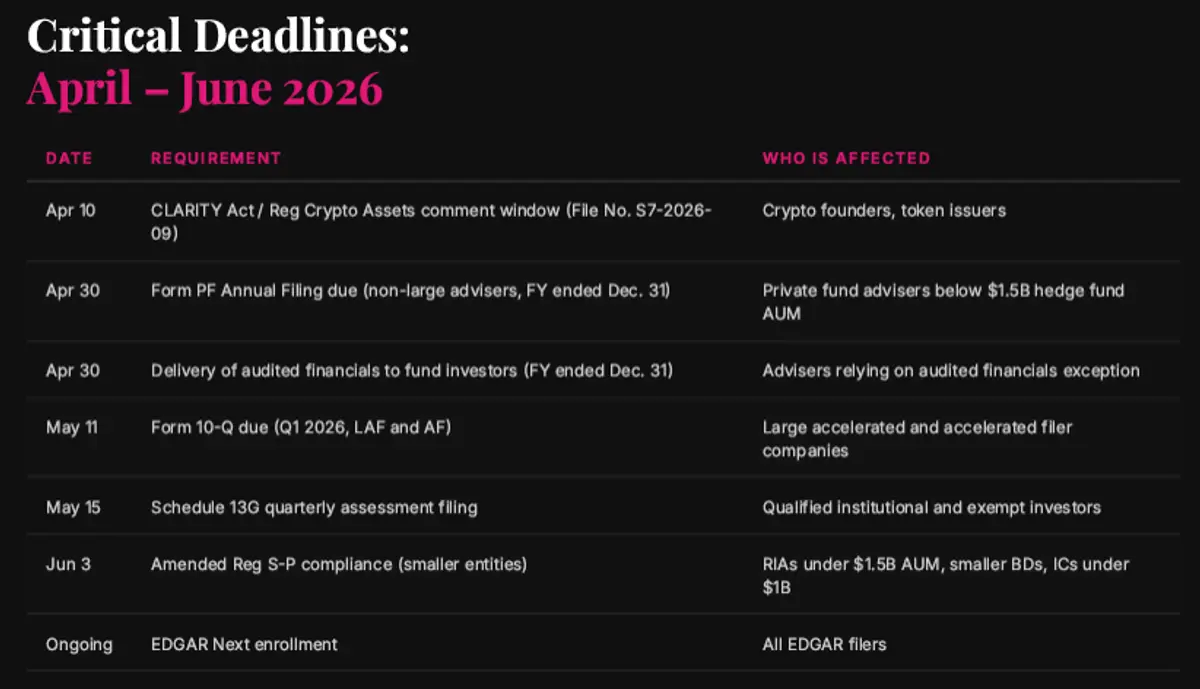
- Compliance Corner: Critical Deadlines
- Action Items
- Spotlight: Enzio
Download the full branded edition below, or read each article on our blog.
In This Edition
SEC and CFTC Harmonization: What Fintech Founders Must Know
For the first time, both agencies are coordinating on digital asset oversight. The implications for your product, your token, and your compliance posture are immediate.
The March 11 MOU commits the agencies to end duplicative examinations, coordinate enforcement before filing parallel actions, and facilitate a path for "super-apps" — unified platforms spanning traditional securities, derivatives, crypto assets, and banking services. The March 17 interpretive release establishes a definitive five-category token taxonomy with immediate practical consequences for how founders structure their products and capital raises.
"For too long, market participants have been forced to navigate regulatory boundaries that are unclear in application and misaligned in design." — Chairman Atkins, Jan. 29, 2026
KEY COMPLIANCE ACTIONS
- Map your token against the five-category taxonomy now.
- Audit every white paper, pitch deck, and Discord announcement for specificity of promises.
- Review your terms of service and privacy policy against your regulatory classification.
- Monitor Regulation Crypto Assets (File No. S7-2026-09) — the proposed startup exemption could change your capital formation strategy.
Tokenizing Securities: What the House Hearing Means for Founders
Congress reached a bipartisan verdict on March 25: tokenized securities are coming. The legal framework isn't ready.The clock on the CLARITY Act is ticking.
The most significant outcome of the March 25 House Financial Services Committee hearing was not legislation — it was a bipartisan, on-the-record acknowledgment that tokenized securities are no longer a question of if, but when, and that the regulatory framework to govern them does not yet fully exist. Across party lines: tokenization does not change the fundamental nature of a security. A tokenized stock is still a stock. The technology changes the infrastructure, not the investor protection requirements.
THE CLOCK IS TIGHT
If the Senate Banking Committee markup slips past late April, Senator Bernie Moreno has stated plainly that digital asset legislation may not move again for years — foreclosed by the midterm election cycle. Founders building tokenization platforms or adjacent products should be tracking this timeline closely and engaging with the comment process now.
What AI-Native Law Firms Mean for Legal Services
Last year, Blackstone invested $50 million in Norm Ai to launch an "AI-native law firm." At FinTech Law, we have been building this model from the inside.
The distinction between AI-adopting and AI-native matters. An AI-adopting firm bolts tools onto existing workflows. An AI-native firm designs every process — client intake, document generation, review cycles, delivery — with AI capabilities in mind from day one. The gap between the two widens every year through data flywheel effects, integrated workflows, and team velocity that large firms simply cannot match.
"The competitive advantage belongs to firms that redesign their delivery models around AI-augmented workflows — not those that buy the same tools and call it transformation." — Bo Howell, FinTech Law
WHAT THIS MEANS FOR FOUNDERS EVALUATING LEGAL COUNSEL
When institutional capital is betting $50 million that AI-native legal services are the future, engaging with firms already building that model is the lower-risk path. Ask your outside counsel about their AI implementation framework — not just the tools they use, but how they have redesigned their workflows around them.
Compliance Corner
Regulation Crypto Assets Alert: The SEC's proposed Regulation Crypto Assets framework (File No. S7-2026-09) contemplates a startup exemption allowing early-stage projects to raise up to approximately $5 million over four years with principles-based disclosures. This is the most significant proposed capital formation pathway for token issuers in a generation. Engage with the comment process now.
Regulation S-P Alert: The June 3 deadline for smaller entities requires written incident response programs, 30-day customer breach notification, enhanced service provider oversight, and compliance recordkeeping. No extension has been granted. This is a 2026 SEC examination priority. If your startup collects user data or handles third-party data obligations, this applies to you.
EDGAR Next Reminder: All EDGAR filers must be enrolled in EDGAR Next. Onboarding delays are common — submit applications well in advance of any filing deadline.

What to Do This Week
Based on this edition's analysis, here are concrete next steps organized by audience:
For Crypto & Digital Asset Founders
- Map your token against the five-category taxonomy from the March 17 SEC-CFTC joint release and document the factual basis for your classification before a regulator or plaintiff forces the analysis.
- Audit your representations — every white paper, pitch deck, website, and Discord announcement. The investment contract analysis now turns on the specificity of what you promised.
- Track the CLARITY Act Senate Banking Committee markup timeline. If it slips past late April, the legislative window may close for years.
- Engage with the Regulation Crypto Assets comment process (File No. S7-2026-09). The proposed startup exemption could meaningfully change your capital formation options.
For Fintech Startups & Founders
- Review your terms of service and privacy policy against your current regulatory classification. The SEC-CFTC framework shifts which agency governs your product — your documents need to reflect that.
- Build your Regulation S-P compliance program now. The June 3 deadline requires a written incident response plan, 30-day breach notification, and updated service provider agreements.
- Assess your outside counsel's AI capabilities. Firms building AI-native practices today will deliver better outcomes at lower cost than those bolting tools onto legacy models.
- Confirm EDGAR Next enrollment — onboarding delays are real and have caused filing deadline issues across the industry.
For Law Firms & Legal Departments
- Audit your AI tools against a disciplined implementation framework. If you skipped objective-setting and workflow mapping, go back — most legal AI projects fail at Stage 1 and 2, not Stage 3.
- Build AI governance before you need it. It is a regulatory expectation in 2026, not a best practice.

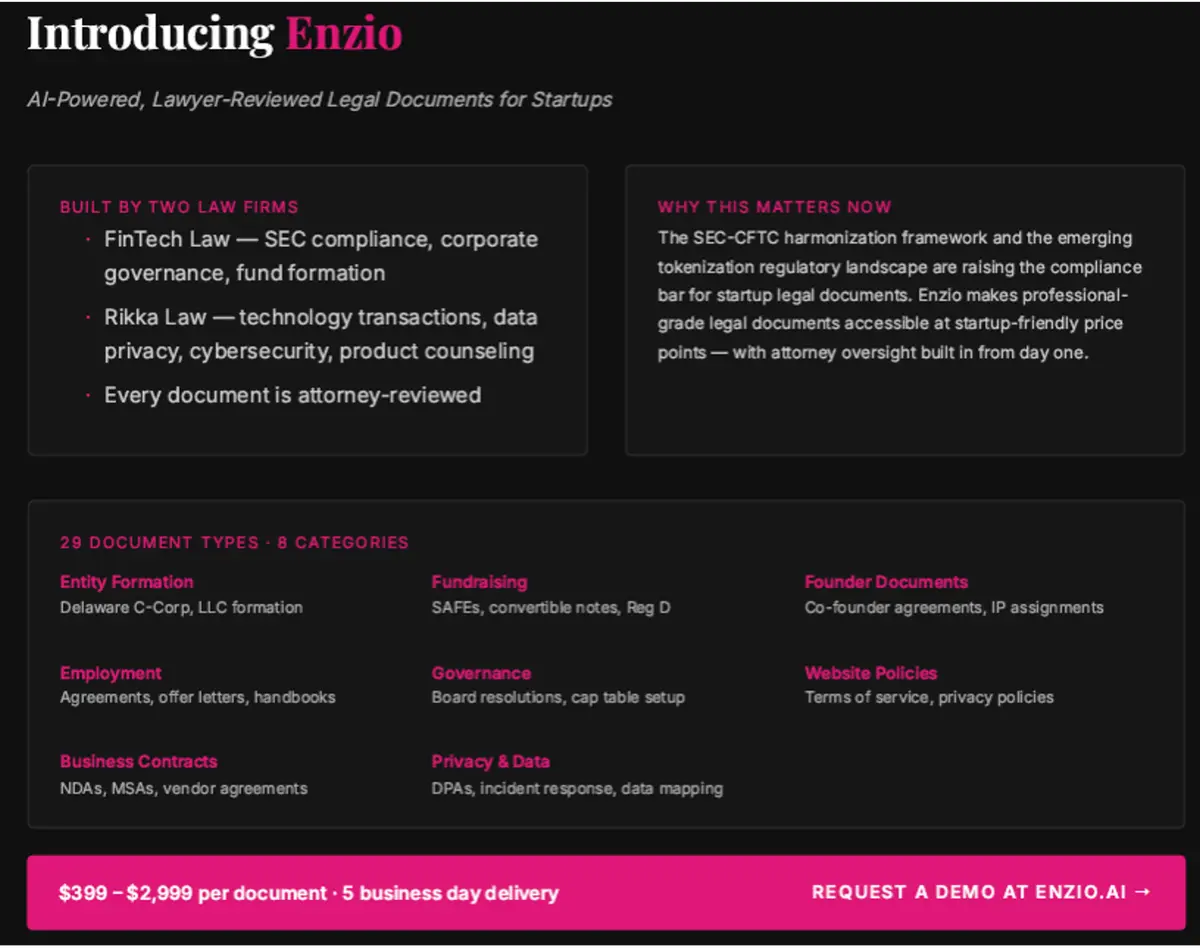
Introducing Enzio: AI-Powered, Lawyer-Reviewed Legal Documents for Startups
We built FinTech Law to serve companies navigating complex regulatory environments. But we kept hearing the same thing from early-stage founders: "I just need a clean NDA," or "I need my Delaware C-Corp formed correctly — I do not need a $25,000 retainer to get started."
They were right. And that gap between what startups need and what traditional legal services deliver is exactly why we built Enzio.
Enzio is an AI-powered legal document platform created by FinTech Law and Rikka Law — two firms with complementary expertise spanning SEC compliance, corporate governance, technology transactions, data privacy, and cybersecurity. Every document on the platform is attorney-reviewed and delivered within five business days at a fixed, transparent price.
What Enzio Covers
The platform offers 29 document types across eight categories — the legal building blocks that every startup needs but few can afford through traditional hourly billing:
- Entity Formation — Delaware C-Corp and LLC formation with bylaws, operating agreements, and stock issuance
- Fundraising — SAFE agreements, convertible notes, and Reg D Form D filings
- Founder Documents — Co-founder agreements, stock purchase agreements, IP assignments
- Employment & Contractors — Employment agreements, offer letters, contractor agreements, employee handbooks
- Governance — Board resolutions, organizational minutes, cap table setup, stockholder consents
- Website Policies — Terms of service, privacy policies, cookie policies, acceptable use policies
- Business Contracts — NDAs and vendor agreements
- Privacy & Data — DPAs, incident response plans, data mapping, security assessments, and privacy training materials
Why This Matters Now
Startups face a compounding problem: the legal work required to launch properly is expensive, but skipping it creates exposure that compounds as you grow. A missing IP assignment at founding becomes a deal-killer at Series A. A generic privacy policy becomes an enforcement risk when the SEC or FTC comes knocking.
Enzio solves this by making professional-grade legal documents accessible at price points that work for pre-revenue and early-stage companies — without sacrificing the attorney oversight that makes those documents defensible.
Pricing ranges from $399 to $2,999 per document. Every document is attorney-reviewed and delivered within five business days.
Know someone who should be reading this? Forward this edition to a colleague. The Startup Solution and The Financial Edge publish biweekly, covering technology and AI, and financial services, respectively.
Need help ensuring compliance and transparency in your fintech company? Contact us today for a consultation.