The Startup Solution - March 2026
The Startup Solution — Technology & AI — March 2026
Nearly 80% of legal departments plan to increase AI investment this year. Fewer than 15% have a governance framework in place. That gap — between enthusiasm and execution — is where most legal AI projects die.
This edition looks at what disciplined AI adoption actually looks like in practice: a proprietary seven-stage implementation framework, a case study of a six-lawyer firm that cut costs 27% and improved results, and the strategic warning behind one of legal's largest AI-attributed layoffs.
We have also added two new sections to The Startup Solution: Compliance Corner, with the regulatory deadlines you need on your calendar right now, and Action Items, translating this edition's insights into concrete next steps for your firm.
IN THIS EDITION
- Seven Stages of AI Implementation for Legal Teams
- A Six-Lawyer Firm Replaced an Associate With AI. Here's the Playbook.
- Baker McKenzie's AI Layoffs Are a Warning
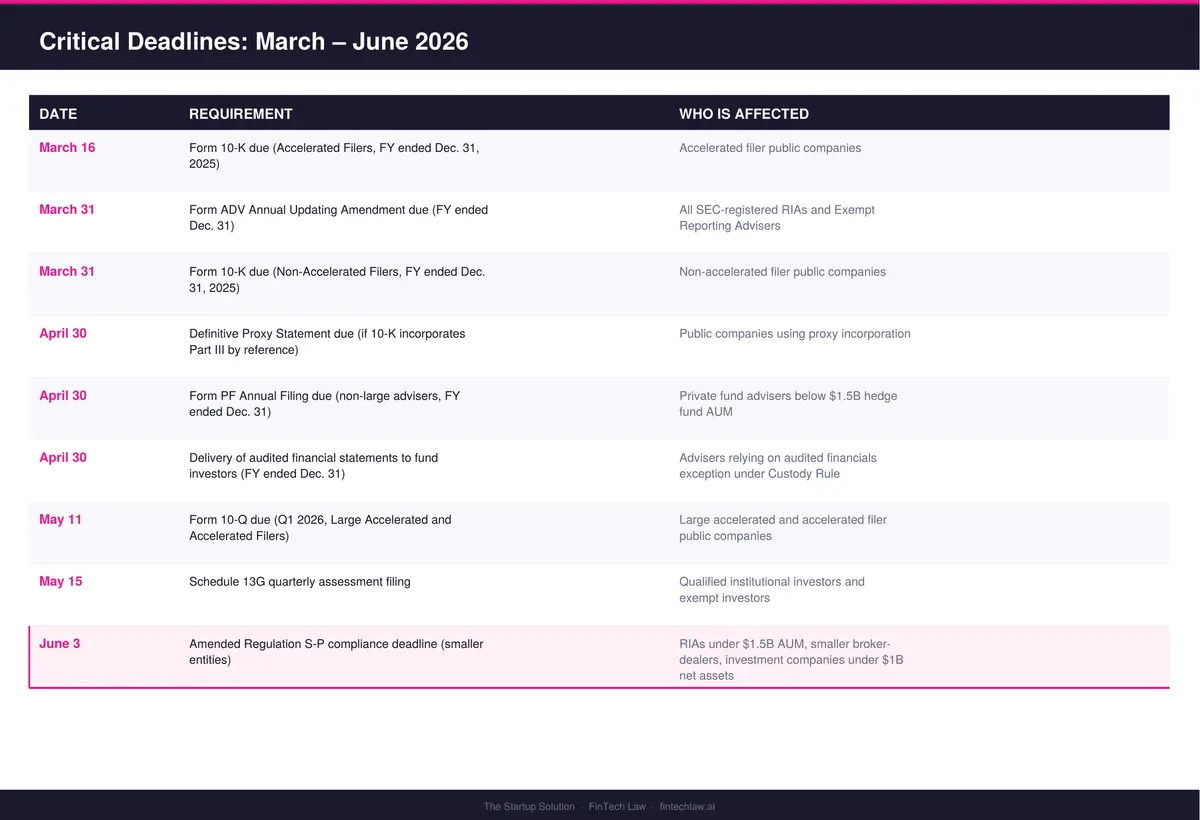
- Compliance Corner: Critical Deadlines
- Action Items
Download the full branded edition below, or read each article on our blog.
In This Edition
Seven Stages of AI Implementation for Legal Teams
A practical framework built from two years of integrating AI into a working corporate and securities law practice — not theory.
80% of legal depts plan to increase AI investment this year | <15% have a governance framework in place | 7 stages from objective-setting to ethics & compliance
Most legal AI projects fail at Stage 1 and Stage 2 — not Stage 3. Organizations rush to buy tools without first defining the problem they are solving or the workflows AI will support. The result: expensive software sitting underused while the operational problems it was supposed to address remain untouched.
Over the past two years building an AI-native practice at FinTech Law, we have refined a seven-stage framework that governs how we evaluate, adopt, and operationalize AI across our legal workflows. The framework applies whether you are a six-lawyer firm, a corporate legal department, or a compliance team at a regulated financial institution.
"Start with the problem, not the tool. If you cannot articulate a specific, measurable objective for an AI tool before you buy it, you are not ready to buy it." — Bo Howell, FinTech Law
The seven stages move from defining objectives and mapping processes through technology selection, systems integration, team training, and ongoing monitoring — with ethics and compliance governance built into the foundation from day one, not retrofitted after a problem surfaces.
KEY TAKEAWAYS
- Define measurable objectives and map your workflows before evaluating any AI platform
- Match technologies to specific workflow problems — no single tool solves everything
- Avoid tools that add steps rather than remove them — if adoption requires more work, it will not stick
- Build governance first, not last — it is cheaper and more effective when foundational
A Six-Lawyer Firm Replaced an Associate With AI. Costs Dropped 27%. Profits Rose.
When an associate left Ad Astra Law Group, managing partner Katy Young asked a question every small firm leader should be asking: does this position actually need to be replaced?
27% drop in staffing costs after AI adoption | 2.5 hrs to draft a complaint that previously took 2 full days | 5% demand growth at midsize firms vs. 2% at Am Law 100 in H2 2025
Ad Astra chose to lean into AI-assisted workflows, partnering with litigation drafting platform Legion to augment their remaining team's capacity. The billing math is the part that trips people up: fewer hours billed at dramatically lower overhead produce stronger profitability — especially when attorneys redirect freed capacity to higher-value work.
The quality dimension is arguably more significant than the cost savings. When a 45-page complaint can be produced in hours rather than days, it changes the strategic calculus of pre-litigation positioning.
"The value proposition of AI in legal practice is not 'the same work, cheaper.' It is 'better work, delivered faster, at a sustainable cost.'" — Bo Howell, FinTech Law
THE PLAYBOOK
- Start with attrition, not layoffs — ask whether AI can absorb the work before reflexively backfilling
- Target your biggest workflow bottleneck first; do not try to automate everything at once
- Establish baselines before adoption so you can measure and demonstrate the impact
- Rethink pricing: fixed-fee and value-based models turn AI efficiency into competitive advantage
Baker McKenzie's AI Layoffs Are a Warning — Not a Playbook
When Baker McKenzie cut 700+ business services staff and pointed at AI, the headlines called it strategy. We called it something else.
Swapping headcount for software licenses is not a legal engineering strategy. It is cost-cutting dressed in innovation language. The firms that confuse the two are setting themselves up for the same overestimation that already burned Salesforce, which discovered by late 2025 that its own AI agents failed the majority of customer experience tasks.
The real distinction is between legal technology — a tool any firm can buy — and legal engineering: the discipline of designing workflows, systems, and organizational structures that integrate technology with human expertise to deliver legal services more effectively.
"Legal engineering is not about the technology at all. It is about building a practice designed to deliver more value, more efficiently, with AI as an integral part of the architecture — not an afterthought bolted onto a legacy business model." — Bo Howell, FinTech Law
The small firm advantage is real. A global firm with 5,000 lawyers faces enormous change management challenges. A six-lawyer firm can make a decision over lunch and implement it by Friday.
KEY TAKEAWAYS
- Replacing headcount with AI without redesigning workflows is not a strategy — it is exposure
- 64% of in-house legal teams expect to reduce outside counsel reliance through AI they are building internally — your clients are not waiting
- Boutique and midsize firms have structural advantages: lower overhead, flexible pricing, faster adoption cycles
- AI governance is a compliance obligation in 2026, not a best practice — build it now
Compliance Corner
Reminder: All EDGAR filers must be enrolled in EDGAR Next. The SEC's new system for account access and management can involve onboarding delays — submit applications well in advance of any filing deadline.
Form ADV Alert: The March 31 deadline is fast approaching. Investment advisers should treat the annual updating amendment as a comprehensive refresh — not a checkbox exercise. The SEC has cited inconsistent disclosures across documents in recent enforcement actions. Ensure your IARD account is funded before filing.
Regulation S-P Alert: The June 3, 2026 compliance deadline for smaller entities is less than three months away. The amended rule requires covered institutions to adopt written incident response programs, notify affected individuals within 30 days of a data breach determination, enhance service provider oversight, and maintain compliance records. Larger entities (RIAs with $1.5B+ AUM) were required to comply by December 3, 2025. Industry trade groups requested a six-month extension, but as of this publication no extension has been granted. If you have not begun building your incident response program and updating your service provider agreements, start now — this is a 2026 SEC examination priority.

What to Do This Week
Based on this edition's analysis, here are concrete next steps organized by firm type:
For Law Firms & Legal Departments
- Audit your AI tools against the Seven Stages framework. If you skipped Stage 1 (defining measurable objectives) or Stage 2 (workflow mapping), go back. Expensive software sitting underused is worse than no software at all.
- Identify your next attrition opportunity. When a position opens, ask the Ad Astra question first: can AI absorb this work? Run the numbers before posting the job.
- Establish baselines now. You cannot demonstrate ROI from AI adoption without pre-adoption metrics. Document current turnaround times, cost per matter, and error rates.
For Investment Advisers & Fund Managers
- File your Form ADV annual amendment before March 31. Confirm IARD funding, review brochure disclosures for accuracy, and cross-check against your website and marketing materials for consistency.
- Calendar the April 30 Form PF deadline if you are a non-large private fund adviser with a December fiscal year end.
- Start your Regulation S-P compliance build now. The June 3 deadline for smaller entities requires a written incident response program, 30-day customer breach notification procedures, updated service provider agreements with 72-hour notification requirements, and compliance recordkeeping. Map the customer data you hold, identify service providers with access, and draft your incident response plan. This is a 2026 SEC examination priority.
- Confirm EDGAR Next enrollment — onboarding delays are real, and you do not want a filing deadline to be the moment you discover the issue.
For Fintech Companies & Startups
- Build AI governance before you need it. If you are integrating AI into compliance, customer-facing, or decision-making workflows, governance frameworks are a regulatory expectation in 2026 — not optional.
- Evaluate your outside counsel's AI capabilities. 64% of in-house teams plan to reduce outside counsel reliance through internal AI. The firms that survive this shift will be the ones already delivering AI-powered efficiency.

Introducing Enzio: AI-Powered, Lawyer-Reviewed Legal Documents for Startups
We built FinTech Law to serve companies navigating complex regulatory environments. But we kept hearing the same thing from early-stage founders: "I just need a clean NDA," or "I need my Delaware C-Corp formed correctly — I do not need a $25,000 retainer to get started."
They were right. And that gap between what startups need and what traditional legal services deliver is exactly why we built Enzio.
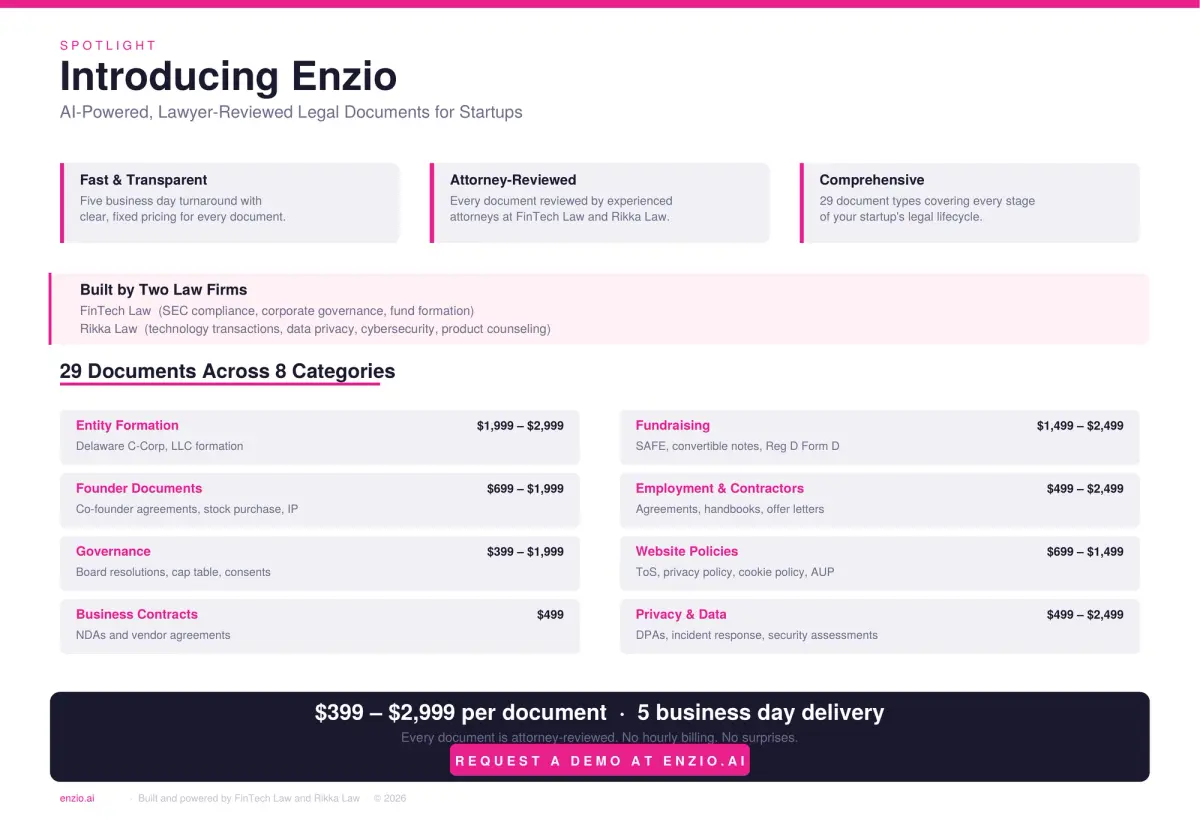
Enzio is an AI-powered legal document platform created by FinTech Law and Rikka Law — two firms with complementary expertise spanning SEC compliance, corporate governance, technology transactions, data privacy, and cybersecurity. Every document on the platform is attorney-reviewed and delivered within five business days at a fixed, transparent price.
What Enzio Covers
The platform offers 29 document types across eight categories — the legal building blocks that every startup needs but few can afford through traditional hourly billing:
- Entity Formation — Delaware C-Corp and LLC formation with bylaws, operating agreements, and stock issuance
- Fundraising — SAFE agreements, convertible notes, and Reg D Form D filings
- Founder Documents — Co-founder agreements, stock purchase agreements, IP assignments
- Employment & Contractors — Employment agreements, offer letters, contractor agreements, employee handbooks
- Governance — Board resolutions, organizational minutes, cap table setup, stockholder consents
- Website Policies — Terms of service, privacy policies, cookie policies, acceptable use policies
- Business Contracts — NDAs and vendor agreements
- Privacy & Data — DPAs, incident response plans, data mapping, security assessments, and privacy training materials
Why This Matters Now
Startups face a compounding problem: the legal work required to launch properly is expensive, but skipping it creates exposure that compounds as you grow. A missing IP assignment at founding becomes a deal-killer at Series A. A generic privacy policy becomes an enforcement risk when the SEC or FTC comes knocking.
Enzio solves this by making professional-grade legal documents accessible at price points that work for pre-revenue and early-stage companies — without sacrificing the attorney oversight that makes those documents defensible.
Pricing ranges from $399 to $2,999 per document. Every document is attorney-reviewed and delivered within five business days.
Know someone who should be reading this? Forward this edition to a colleague. The Startup Solution and The Financial Edge publish biweekly, covering technology and AI, and financial services, respectively.
Need help ensuring compliance and transparency in your fintech company? Contact us today for a consultation.