The Financial Edge - April 2026
The Financial Edge — Financial Services — April 2026
On April 1, the Justice Department filed court documents proposing to cut the CFPB's workforce from 1,174 to 556 — including an 80% reduction in enforcement staff and an 85% cut to the supervision division. The headlines focused on what this means for the Bureau. I want to focus on what it means for you.
The CFPB's statutory authority does not shrink with its headcount. The Consumer Financial Protection Act, TILA, and EFTA remain fully in force. What changes is who enforces them — and the answer is increasingly state attorneys general, state financial regulators, and plaintiffs' attorneys watching enforcement gaps closely.
This edition covers the compliance implications of the CFPB's restructuring, the SEC's new five-category crypto asset taxonomy and what it means for financial services clients building in digital assets, and the concrete steps your compliance program needs before the regulatory picture settles.
In This Edition
- CFPB Workforce Cuts: What Fintech Startups Must Do Now
- The SEC's Enforcement Reset: What the FY2025 Results Mean for Fintech Firms
- The SEC's New Crypto Playbook: Five Categories Every Founder Needs to Know
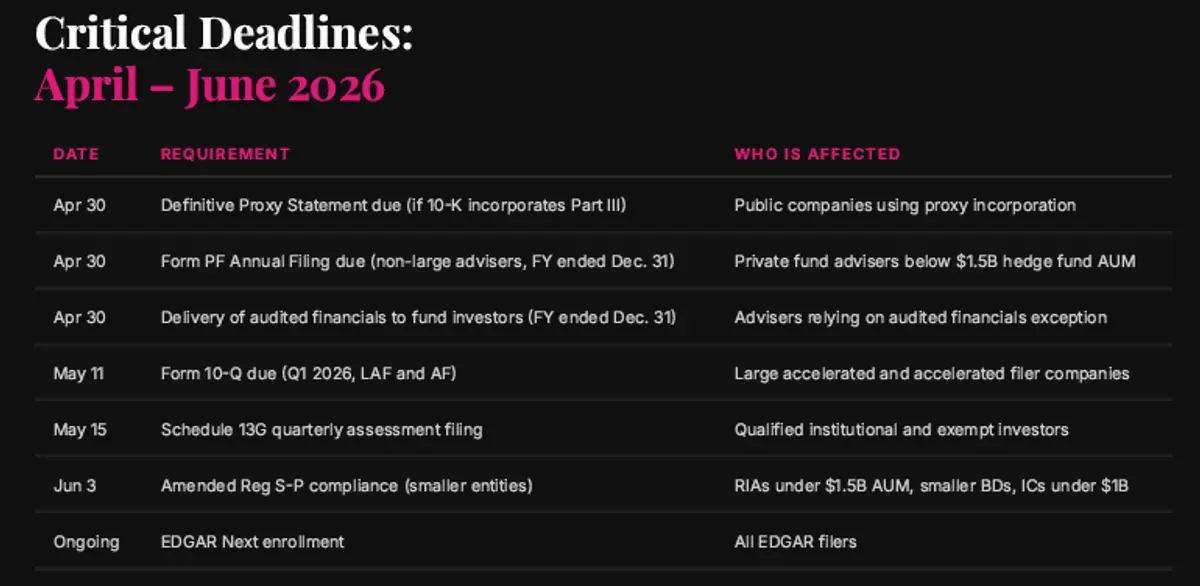
- Compliance Corner: Critical Deadlines
- Action Items
- Spotlight: Enzio
Download the full branded edition below, or read each article on our blog.
In This Edition
CFPB Workforce Cuts: What Fintech Startups Must Do Now
The CFPB's statutory authority survives its workforce reduction. The Consumer Financial Protection Act, TILA, and EFTA remain fully in force regardless of how many examiners are on payroll. The administration's own court filing acknowledged this — the revised reduction-in-force plan was structured to show the bureau can still "meet its statutory obligations" at 556 employees.
"The supervision gap is real and measurable. The liability gap does not exist." — Bo Howell, FinTech Law
TWO DYNAMICS TO WATCH
- State regulators filling the vacuum. NY, CA, and IL have each signaled expanded enforcement. A patchwork of state regulators now replaces CFPB as primary risk.
- Private litigation risk rising. The GAO documented 56 withdrawn enforcement actions — resolving only seven, continuing just nine. Plaintiffs' attorneys are watching.
NTEU V. VOUGHT — LITIGATION TO WATCH
The D.C. Circuit Court of Appeals is considering whether to lift the stay blocking the CFPB workforce reduction. A ruling permitting the cuts would accelerate the shift of consumer financial protection enforcement to state regulators. Monitor this litigation and ensure your state-level compliance posture is current regardless of outcome.
The SEC's Enforcement Reset: What FY2025 Results Mean for Your Firm
The current Commission has stepped back from off-channel communications penalties (95 prior actions, $2.3B in penalties), crypto registration cases (7 dismissed since Feb. 2025), and novel "dealer definition" theories. It has not stepped back from fraud, manipulation, fiduciary duty enforcement, or individual accountability.
FOR INVESTMENT ADVISERS
The FamilyWealth advisory agreement action and the Vanguard conflict of interest action are the current enforcement roadmap. Fiduciary duty enforcement — conflicts, disclosure failures, breaches of trust — has not been deprioritized. Self-reporting and cooperation continue to produce meaningfully better outcomes.
The SEC's New Crypto Playbook: Five Categories Every Founder Needs to Know
After more than a decade of regulatory ambiguity, the SEC has finally drawn the lines.
FIVE TOKEN CATEGORIES ESTABLISHED
- Digital Commodities: Bitcoin, Ethereum, Solana, XRP — linked to functional networks. CFTC jurisdiction. Not securities.
- Digital Collectibles: NFTs and meme coins. Generally not securities — unless fractionalization or revenue-sharing creates investment contract risk.
- Digital Tools: Memberships, credentials, identity badges — consumed or used, not held as investments. Not securities.
- Payment Stablecoins: Stablecoins meeting the GENIUS Act definition excluded by statute. Others subject to facts-and-circumstances analysis.
- Digital Securities: Tokenized stocks, bonds, ETFs — fully subject to SEC registration, disclosure, and exchange requirements regardless of blockchain delivery.
THE INVESTMENT CONTRACT QUESTION IS NOT GOING AWAY
A token in a non-security category can still become a security if offered as part of an investment contract. The analysis now turns on the specificity of issuer representations — detailed roadmaps and performance commitments create investment contract risk that vague aspirational language does not. Classify your token and document the factual basis now. The classification is only as strong as the record supporting it.
WATCH: REGULATION CRYPTO ASSETS (FILE NO. S7-2026-09)
Chairman Atkins has previewed a startup exemption allowing early-stage projects to raise up to approximately $5 million over four years with principles-based disclosures. This is not law yet — but it signals the Commission's intent to create viable pathways for compliant token offerings. Engage with the comment process now.
Compliance Corner
NTEU v. Vought — Litigation to Watch: The D.C. Circuit is considering lifting the stay blocking the CFPB workforce reduction. A ruling permitting the cuts would immediately accelerate state-level consumer financial protection enforcement. Financial services companies should ensure their state compliance posture is current regardless of how the court rules.
Regulation S-P Alert: The June 3 deadline for smaller entities requires written incident response programs, 30-day customer breach notification, enhanced service provider oversight, and compliance recordkeeping. No extension has been granted. This is a 2026 SEC examination priority. Investment advisers and broker-dealers should be building this program now.
EDGAR Next Reminder: All EDGAR filers must be enrolled in EDGAR Next. Onboarding delays are common — submit applications well in advance of any filing deadline.

What to Do This Week
Based on this edition's analysis, here are concrete next steps organized by firm type:
For Fintech Companies & Digital Asset Platforms
- Audit your consumer-facing documents — terms of service, privacy policy, and consumer disclosures — against current CFPB rules and applicable state consumer protection statutes. The most exposed companies in a state enforcement environment are those whose documents were drafted for a federal-primary world.
- Map your state money transmitter licensing posture. Stablecoin transfers, crypto-to-fiat conversions, and digital asset payments may require multi-state licenses. State regulators have initiated enforcement actions independently of any federal coordination.
- Classify your token against the five-category taxonomy from the March 17 SEC-CFTC joint release. Document the factual basis now — the classification is only as strong as the record supporting it.
For Investment Advisers & Fund Managers
- Review your advisory agreements for hedge clause language, assignment provisions, and trading authorization language. The FamilyWealth enforcement action from January 2026 remains the roadmap for what examiners are looking for this year.
- Start your Regulation S-P compliance build immediately. The June 3 deadline requires a written incident response program, 30-day breach notification, and updated service provider agreements. No extension has been granted.
- Confirm EDGAR Next enrollment — onboarding delays are real and have caused filing deadline issues across the industry.
For Fund Boards & Compliance Officers
- Assess your SEC enforcement exposure in digital assets separately from CFPB developments. The March 17 joint release makes clear that digital asset oversight is strengthening at the federal level. CFPB uncertainty does not reduce SEC scrutiny.
- Monitor the NTEU v. Vought litigation. A ruling permitting the CFPB workforce reduction would accelerate state enforcement activity — ensure your state-level compliance posture is current regardless of outcome.

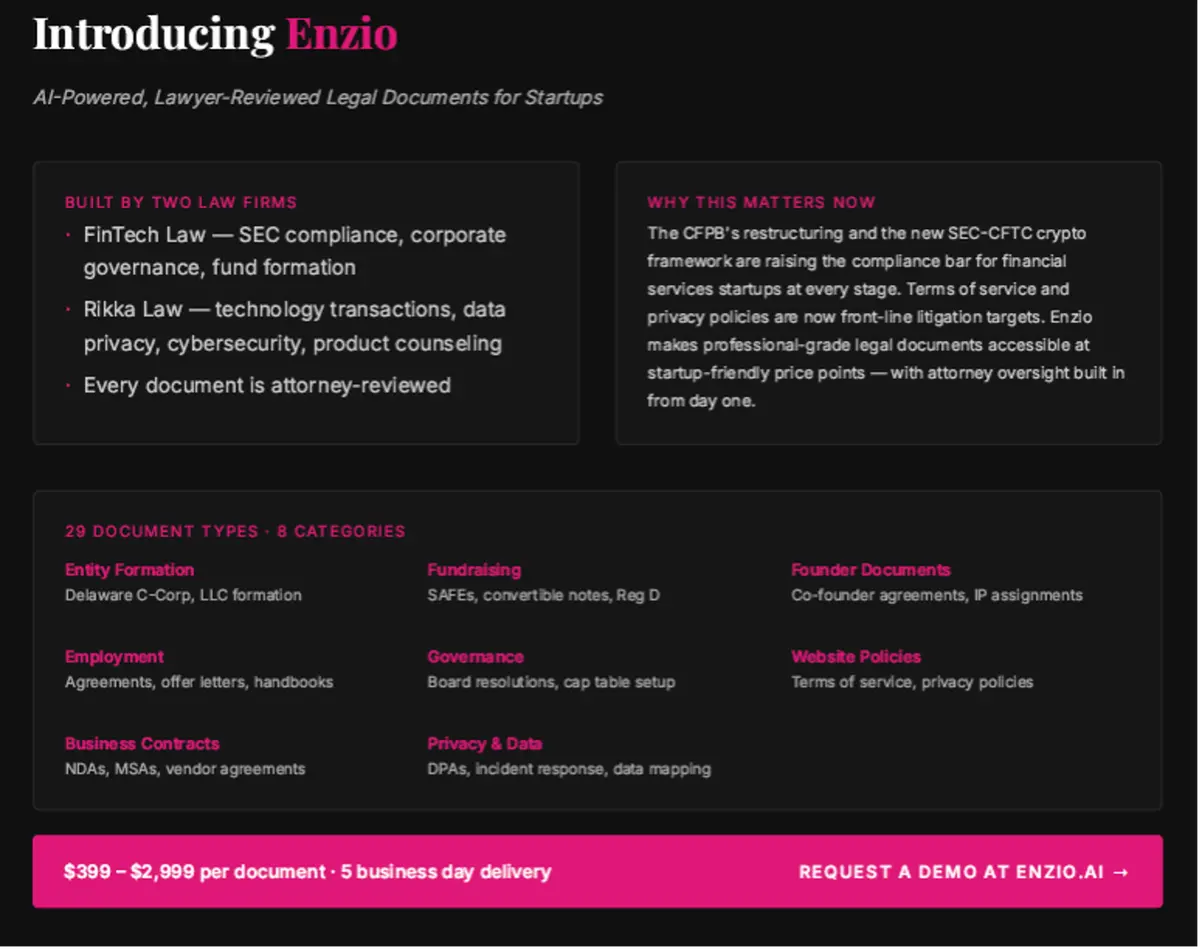
Introducing Enzio: AI-Powered, Lawyer-Reviewed Legal Documents for Startups
We built FinTech Law to serve companies navigating complex regulatory environments. But we kept hearing the same thing from early-stage founders: "I just need a clean NDA," or "I need my Delaware C-Corp formed correctly — I do not need a $25,000 retainer to get started."
They were right. And that gap between what startups need and what traditional legal services deliver is exactly why we built Enzio.
Enzio is an AI-powered legal document platform created by FinTech Law and Rikka Law — two firms with complementary expertise spanning SEC compliance, corporate governance, technology transactions, data privacy, and cybersecurity. Every document on the platform is attorney-reviewed and delivered within five business days at a fixed, transparent price.
What Enzio Covers
The platform offers 29 document types across eight categories — the legal building blocks that every startup needs but few can afford through traditional hourly billing:
- Entity Formation — Delaware C-Corp and LLC formation with bylaws, operating agreements, and stock issuance
- Fundraising — SAFE agreements, convertible notes, and Reg D Form D filings
- Founder Documents — Co-founder agreements, stock purchase agreements, IP assignments
- Employment & Contractors — Employment agreements, offer letters, contractor agreements, employee handbooks
- Governance — Board resolutions, organizational minutes, cap table setup, stockholder consents
- Website Policies — Terms of service, privacy policies, cookie policies, acceptable use policies
- Business Contracts — NDAs and vendor agreements
- Privacy & Data — DPAs, incident response plans, data mapping, security assessments, and privacy training materials
Why This Matters Now
Startups face a compounding problem: the legal work required to launch properly is expensive, but skipping it creates exposure that compounds as you grow. A missing IP assignment at founding becomes a deal-killer at Series A. A generic privacy policy becomes an enforcement risk when the SEC or FTC comes knocking.
Enzio solves this by making professional-grade legal documents accessible at price points that work for pre-revenue and early-stage companies — without sacrificing the attorney oversight that makes those documents defensible.
Pricing ranges from $399 to $2,999 per document. Every document is attorney-reviewed and delivered within five business days.
Know someone who should be reading this? Forward this edition to a colleague. The Startup Solution and The Financial Edge publish biweekly, covering technology and AI, and financial services, respectively.
Need help ensuring compliance and transparency in your fintech company? Contact us today for a consultation.