The Financial Edge - March 2026
The Financial Edge — Financial Services — March 2026
The SEC published three significant reports on a single day in early February, and taken together they tell a coherent story about where regulatory attention is heading in 2026. Active ETFs are growing fast enough that the Commission felt compelled to quantify their risk characteristics. Fund mergers are consolidating the industry, but the fee relief investors expect is not evenly distributed. And private markets now raise twice as much capital as public markets, with regulatory reform potentially widening that gap.
This edition translates each report into what it means for fund boards, compliance teams, and capital-raising strategies — plus the hedge clause enforcement action you cannot afford to miss.
In This Edition
- Active ETFs Are Booming — Is Your Compliance Framework Ready?
- Fund Mergers Cut Fees — But Not Equally
- SEC Report Shows Private Markets Dominate Capital Raising
- SEC Hedge Clause Crackdown
- Compliance Corner: Critical Deadlines
- Action Items
- Spotlight: Enzio
Download the full branded edition below, or read each article on our blog.
In This Edition
Active ETFs Are Booming — Is Your Compliance Framework Ready?
Active ETFs are no longer the little sibling of passive index funds. The SEC's Division of Economic and Risk Analysis (DERA) just confirmed what the market already suspected: active ETFs are a structural force reshaping investment management — and your compliance infrastructure needs to keep pace.
DERA found that active ETFs exhibit meaningfully different portfolio characteristics compared to passive funds: lower return alignment with underlying benchmarks, higher portfolio turnover rates, and greater use of derivatives. Each carries distinct compliance obligations that fund boards cannot afford to overlook.
"Compliance frameworks built for a predominantly passive ETF world are due for a serious upgrade. The SEC's decision to publish this DERA report signals the agency's intent to scrutinize this market segment more closely." — Bo Howell, FinTech Law
KEY COMPLIANCE IMPLICATIONS
- Derivatives Risk — Rule 18f-4: Active ETFs' greater derivatives usage places Rule 18f-4 at the center of compliance planning. Boards should verify that risk management programs reflect actual trading activity — not assumed usage.
- Portfolio Transparency — Rule 6c-11: Daily holdings disclosure becomes operationally demanding for high-turnover active strategies. Boards should confirm current systems can handle the pace active management demands.
- Section 15(c) Fee Review: Investors pay an average of 25 basis points more for active strategies. That premium makes the annual fee evaluation critical — especially given DERA's findings on limited benchmark deviation in some active products.
- Multi-Share Class Conversions: With nearly 80 applicants queued for approval, boards overseeing mutual fund-to-ETF conversions should engage counsel early on governance, pricing, and cross-wrapper compliance.
Fund Mergers Cut Fees — But Not Equally
Fund mergers generally reduce fees for investors — but the magnitude depends heavily on fund type and merger structure. DERA's analysis of over 1,800 mutual fund and ETF mergers between 2011 and 2023 provides the most comprehensive empirical look at merger economics available, and the findings carry direct implications for fund boards evaluating consolidation proposals.
WHERE THE SAVINGS ARE — AND AREN'T
Mixed and bond funds benefit most. Mixed funds saw a 4.49 basis point reduction in management fees; bond funds dropped 1.41 basis points. Equity funds showed no statistically significant management fee change at all —suggesting boards overseeing equity fund mergers should scrutinize projections premised primarily on cost savings.
Merger structure matters as much as fund type. Cross-family mergers and share class consolidations drove the largest expense ratio reductions at 2.26 basis points each. Within-family mergers — the most common structure at 65% of all activity — showed no statistically significant overall expense ratio impact.
One finding will surprise no one in fund administration: 12b-1 fees remain essentially unchanged after mergers. Distribution agreements and regulatory caps make these fees structurally resistant to renegotiation. Any merger proposal projecting material 12b-1 savings deserves healthy skepticism.
"The fee savings story in fund mergers is really about expense ratios and management fees — not distribution costs. Boards should require advisers to break down projected savings at that level of granularity." — Bo Howell, FinTech Law
KEY TAKEAWAYS FOR FUND BOARDS
- Use DERA's findings as a benchmark in Section 15(c) analysis — are projected savings in line with industry norms for your fund type and merger structure?
- Equity fund merger projections warrant extra diligence; the data shows minimal fee relief for this category
- Lower fees do not guarantee better returns — post-merger performance can be affected by integration in efficiencies and diseconomies of scale.
SEC Report: Private Markets Now Raise Twice as Much as Public Markets
Rule 506(b) placements raised $1.8 trillion in FY2024 versus $28 billion in IPOs — and the $526K annual cost of public company status keeps companies private longer. Regulation D is the dominant strategy, not a fallback. Under Chairman Atkins, reform to accredited investor definitions and Regulation D requirements may widen that advantage, while VC concentration above $500M leaves a substantial, underserved market for emerging managers.
SEC Hedge Clause Crackdown: A $150,000 Warning on Boilerplate
The SEC's January 2026 settled charges against FamilyWealth Advisers produced $150,000 in penalties for advisory agreement language alone — hedge clauses disclaiming ordinary negligence, improper assignment provisions, and custody violations from trading authorization language. Add a reasonable care qualifier to liability disclaimers, include negligence in the liability standard, ensure assignment provisions require client consent, and conduct a custody analysis before your next examination.
"Proactive agreement review costs a fraction of enforcement penalties. The SEC's FY 2026 Examination Priorities specifically highlight fiduciary duty compliance. Now is the time to review your agreements before examiners do it for you." — Bo Howell, FinTech Law
Compliance Corner
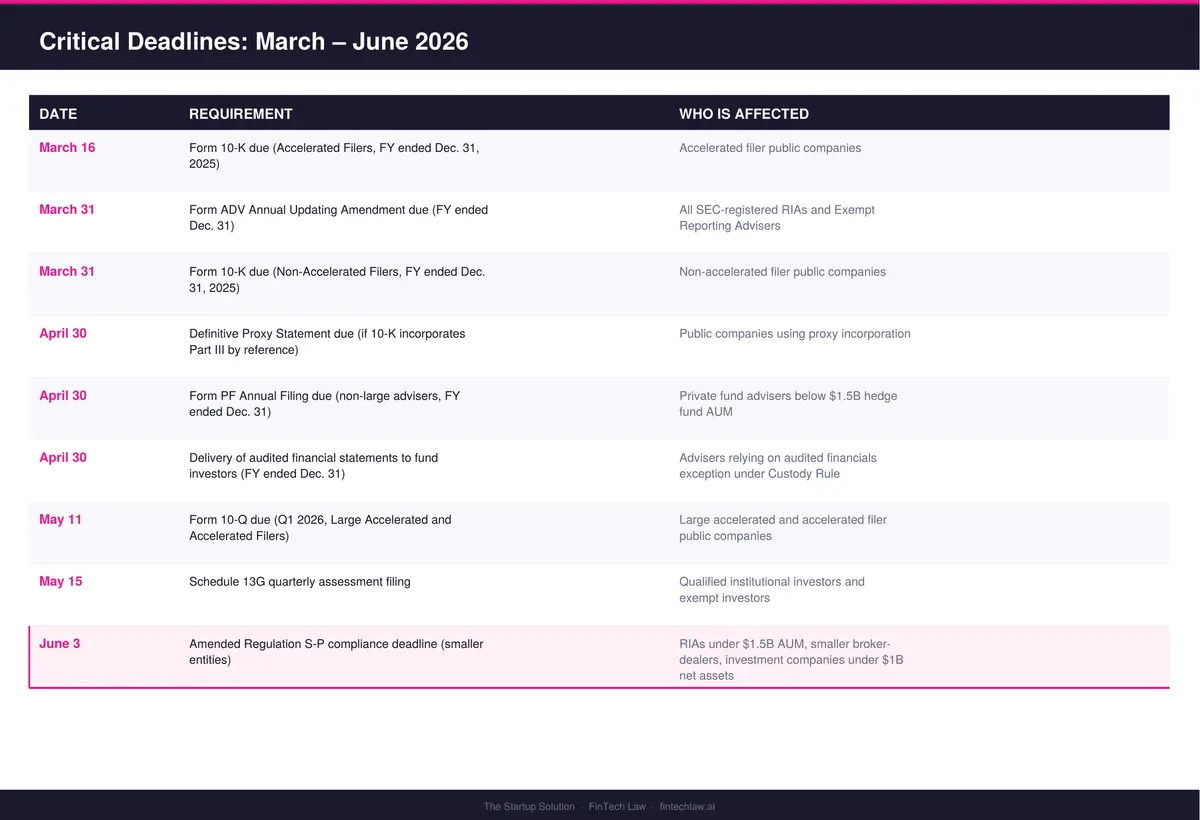
Reminder: All EDGAR filers must be enrolled in EDGAR Next. The SEC's new system for account access and management can involve onboarding delays — submit applications well in advance of any filing deadline.
Form ADV Alert: The March 31 deadline is here. Investment advisers should treat the annual updating amendment as a comprehensive refresh — not a checkbox exercise. The SEC has cited inconsistent disclosures across documents in recent enforcement actions. Ensure your IARD account is funded before filing.
Regulation S-P Alert: The June 3, 2026 compliance deadline for smaller entities is about two months away. The amended rule requires covered institutions to adopt written incident response programs, notify affected individuals within 30 days of a data breach determination, enhance service provider oversight, and maintain compliance records. Larger entities (RIAs with $1.5B+ AUM) were required to comply by December 3, 2025. Industry trade groups requested a six-month extension, but as of this publication no extension has been granted. If you have not begun building your incident response program and updating your service provider agreements, start now — this is a 2026 SEC examination priority.

What to Do This Week
Based on this edition's analysis, here are concrete next steps organized by firm type:
For Fund Boards & Chief Compliance Officers
- Audit your active ETF compliance framework against Rule 18f-4, Rule 6c-11, and Section 15(c) obligations. If your fund's derivatives risk management program was written for a passive strategy, it needs updating.
- If a fund merger is on the table, request fee projections broken down by component — management fees, expense ratios, and 12b-1 fees — and benchmark them against DERA's published findings for your fund type and merger structure.
- For multi-share class ETF conversions: engage counsel now on governance, pricing, and cross-wrapper compliance obligations. The approval queue is long and the structural complexity is real.
For Investment Advisers
- Review your advisory agreements for hedge clause language, assignment provisions, and trading authorization language that may trigger custody obligations. The FamilyWealth action is a roadmap for what examiners are looking for in 2026.
- File your Form ADV annual amendment immediately. Cross-check disclosures for consistency and confirm your IARD account is funded before the March 31 deadline.
- Start your Regulation S-P compliance build now. The June 3 deadline requires a written incident response program, 30-day breach notification, and updated service provider agreements. No extension has been granted.
- Confirm EDGAR Next enrollment — onboarding delays are real and have caused filing deadline issues across the industry.
For Fund Managers & Capital Raisers
- If you are approaching structural limits under Section 3(c)(1) or frustrated by Rule 506(c) verification burdens, monitor the SEC's regulatory agenda closely. Chairman Atkins has signaled reform in both areas.
- If your capital needs fall in the $20–75M range and you want participation from non-accredited investors, evaluate whether Regulation A Tier 2 fits your strategy — it raised $1.5B in FY2024 and may be underused for the right situation.

Introducing Enzio: AI-Powered, Lawyer-Reviewed Legal Documents for Startups
We built FinTech Law to serve companies navigating complex regulatory environments. But we kept hearing the same thing from early-stage founders: "I just need a clean NDA," or "I need my Delaware C-Corp formed correctly — I do not need a $25,000 retainer to get started."
They were right. And that gap between what startups need and what traditional legal services deliver is exactly why we built Enzio.
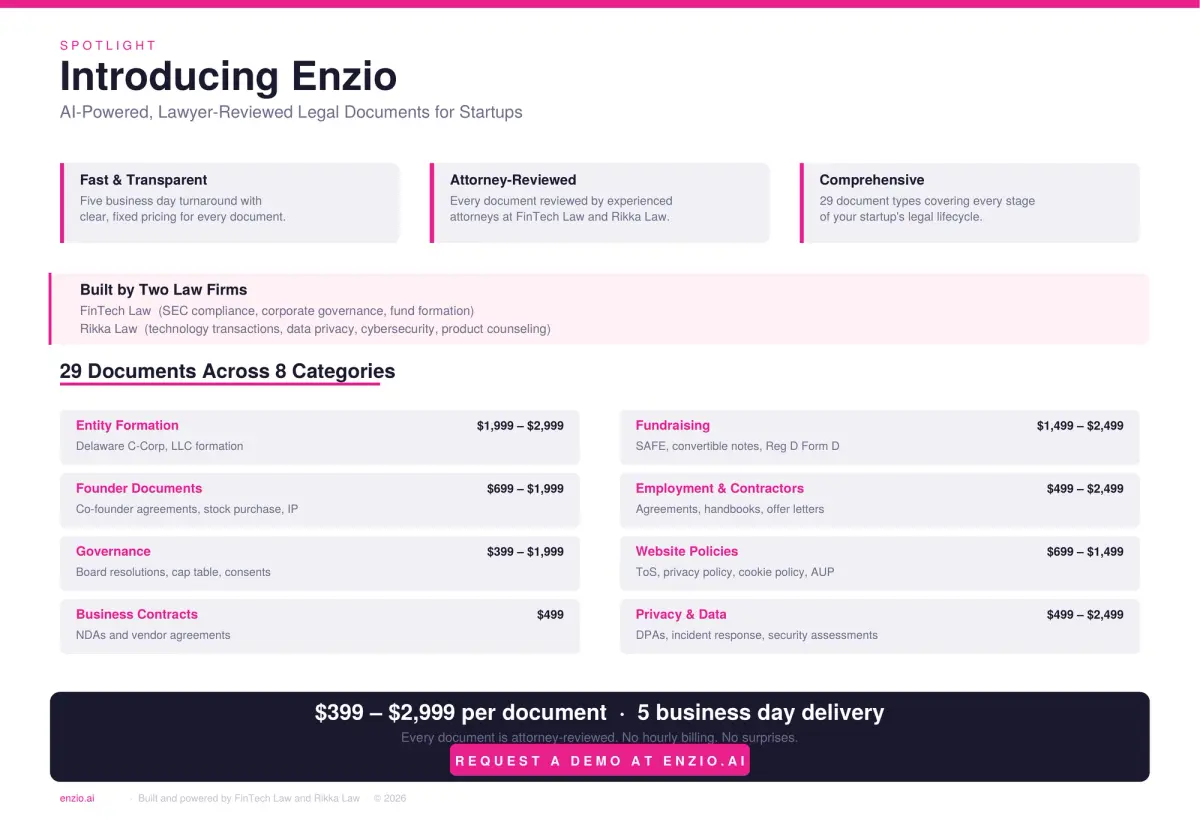
Enzio is an AI-powered legal document platform created by FinTech Law and Rikka Law — two firms with complementary expertise spanning SEC compliance, corporate governance, technology transactions, data privacy, and cybersecurity. Every document on the platform is attorney-reviewed and delivered within five business days at a fixed, transparent price.
What Enzio Covers
The platform offers 29 document types across eight categories — the legal building blocks that every startup needs but few can afford through traditional hourly billing:
- Entity Formation — Delaware C-Corp and LLC formation with bylaws, operating agreements, and stock issuance
- Fundraising — SAFE agreements, convertible notes, and Reg D Form D filings
- Founder Documents — Co-founder agreements, stock purchase agreements, IP assignments
- Employment & Contractors — Employment agreements, offer letters, contractor agreements, employee handbooks
- Governance — Board resolutions, organizational minutes, cap table setup, stockholder consents
- Website Policies — Terms of service, privacy policies, cookie policies, acceptable use policies
- Business Contracts — NDAs and vendor agreements
- Privacy & Data — DPAs, incident response plans, data mapping, security assessments, and privacy training materials
Why This Matters Now
Startups face a compounding problem: the legal work required to launch properly is expensive, but skipping it creates exposure that compounds as you grow. A missing IP assignment at founding becomes a deal-killer at Series A. A generic privacy policy becomes an enforcement risk when the SEC or FTC comes knocking.
Enzio solves this by making professional-grade legal documents accessible at price points that work for pre-revenue and early-stage companies — without sacrificing the attorney oversight that makes those documents defensible.
Pricing ranges from $399 to $2,999 per document. Every document is attorney-reviewed and delivered within five business days.
Know someone who should be reading this? Forward this edition to a colleague. The Startup Solution and The Financial Edge publish biweekly, covering technology and AI, and financial services, respectively.
Need help ensuring compliance and transparency in your fintech company? Contact us today for a consultation.